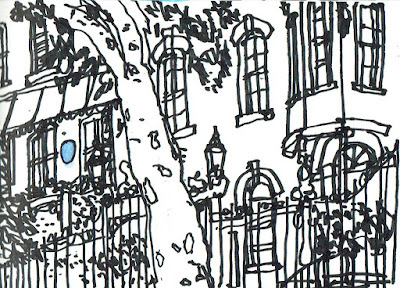
London's Urban Sketchers group met at the Natural History Museum last weekend. The conversations and support from the people who go is always more important to me than the actual act of drawing on the day. I spent a bit of time outside the museum drawing people having a good time on the ice rink, and I offer that page from my sketchbook to you here with whatever season's greeting is appropriate to you. Here's to 2020.
There's more information about London's Urban Sketchers here, and you can see more of my drawings on Instagram.
Showing posts with label London. Show all posts
Friday, 20 December 2019
Sunday, 8 December 2019
From London Calling to Never Mind the Bollocks
I’d passed the unassuming church hall behind this church in Highbury New Park around the corner from where we live hundreds of times before I found out that it was, from the 1960s to 2003, a recording studio once owned by George Martin. Here, as the Wessex Studios, the Clash recorded the London Calling album, and the Sex Pistols recorded Never Mind the Bollocks.
As if that wasn’t enough, Tina Turner, Jimi Hendrix, the Specials, Nick Cave, Queen, Madonna, Bjork, the Three Degrees, Elton John, Kylie, the Rolling Stones and many more worked there. The building has now been split up into residential apartments, imaginatively named The Recording Studio.
The writer Douglas Adams lived for a while in a flat in the house immediately next to the church.
Wednesday, 10 April 2019
This sketchbook: from Brexit to Google's new HQ
Here are six pages from one of my current sketchbooks: an A6 one that I generally use across an open page so the gutter runs down the centre of each image (and hence down the centre of this blog post). The sketchbooks always end up telling a kind of story through what I have drawn in them, and during this one (so far) it seems I have been demonstrating against Brexit (above), travelling on the train to see my dad, drinking coffee in cafes, walking with N, and watching London's skyline change. Here they are, in no particular order.
![]() |
| From the London to Market Harborough train |
![]() |
| A walk around Woodberry Wetlands |
![]() |
| Cafe in Bloomsbury |
![]() |
| St Martin-in-the-Fields and South African Embassy, Trafalgar Square, London |
![]() |
| London's new Google HQ rises in King's Cross |
Monday, 19 November 2018
On letting go
I've often thought that the process of drawing has similarities with the ups and downs of form experienced by sportspeople. Sometimes things flow effortly, and then at other times it can seem like hard work, when nothing goes as you'd hoped. I was reminded of this while reading On Cricket, a new book by the former England captain and psychoanalyst Mike Brearley. A passage in it refers to playfulness and losing inhibitions:
"... I think that writing, like playing cricket, like, in fact, many activities of life, involves at best a benign sort of marriage between discipline and spontaneity, between hard work and playfulness, between letting go of conscious control and the application of sometimes critical thought."
Of course, it doesn't always work out as you'd like. The playfulness can easily come unstuck. In terms of drawing, that is what sketchbooks can be for: an arena for coming unstuck and being spontaneous, and occasionally, sometimes (and not necessarily in the images included here) an uninhibited zone where you can happily surprise yourself, buoyed up by all that experience, hard work and discipline. And not mind whether they gather two likes on social media or two thousand.
From the top: the view from the top of Tate Modern looking towards Blackfriars Bridge, three scenes from a moving train going to the Midlands from London, and Cornelia Parker's Transitional Object (PsychoBarn) in the courtyard of the Royal Academy, London.
Monday, 16 July 2018
When Trump came to London
When US president Trump came to London last week I found time to join the demonstrating crowds at Parliament Square. Like other demonstrations I have attended, it was impossible not to be drawn into its good-natured humour, and its combination of frank and understated responses delivered through banners and placards. There were a lot of people from the US attending too, from either side of the Trump divide, some hoping for his 2020 re-election, and some professing shame and embarrassment at what they see their leader as standing for.
I drew the scene, quite quickly, and posted it on Instagram, along with a simple description of where I was, and what I had drawn. I readily admit it isn't a great drawing – I found myself caught between two columns of marchers as they passed from Whitehall into the square, and so conditions were a little cramped – but in the spirit of the moment I shared it online within minutes of doing it. The symbol of the day, the inflated Baby Trump blimp, and the focus of my drawing, was more orange than I show it, but it had passed quickly, and was then lost in the melee. I had time for one drawing to capture the event, and this was it.
My Instagram images had never before been reposted by the official Urban Sketchers feed, and I had no expectation of this one being shared with its 155,000 followers, so it came as a surprise when it was. The response from my own much more modest number of followers was supportive and even enthusiastic. On the USk shared post it was less so. There seemed to be a feeling that while images of a political nature were fine for Facebook, Instagram was for drawings of a more refined nature. "Leave this shit to FB PLZ," and "If @urbansketchers starts getting political, I’m gone," were among the much-liked responses.
I know perfectly well that my Trump blimp drawing fits exactly into the Urban Sketchers manifesto, so I make no apologies for that. And my drawing was free of any information about my own feelings about Trump, which I'll leave you to successfully guess at. I was most interested to find out that Instagram is considered a contention-free channel, and that Facebook is instead the place for the political stuff. (I'm on Facebook, mainly because I have overseas friends, and books to publicise, but I generally don't engage with it, particularly since its well-publicised record of carelessness with its users' data and involvement with Cambridge Analytica.) More than that, it was suggested by some that Urban Sketchers was not a place for reportage to be shared or reposted.
Most of my drawings are not overtly political, but the occasional one is. It would have been odd for me to have been in central London on Friday 13 July 2018 and not drawn the Trump blimp and the demonstration, just as it would have been weird not to have drawn the collapse of the wall in Berlin on 9 November 1989 or the Civil Rights march in Washington on 28 August 1963. Anyhow, here are a couple more politically related drawings of mine.
![]() |
| Anti-Muslim travel ban march, Whitehall, London, 4 February 2017 |
![]() |
| Jeremy Corbyn arrives at Union Chapel, Islington on the eve of the 2017 General Election |
I'm off to pack for Porto now.
Thursday, 26 April 2018
London's squares: Tavistock and Cavendish
With the onset of spring, I've found myself lazing in London's squares more than once. These two drawings show Cavendish Square (above), handily placed behind John Lewis on Oxford Street for post-consumerist recovery, and Tavistock Square (below), which is one of many lovely Bloomsbury squares close to where I have been working at the UCL Institute of Education.
I've written a longer post about five of London's squares on the Urban Sketchers blog.
You can follow me on Instagram and even Flickr.
Sunday, 22 April 2018
Stephen Lawrence's memorial, London SE9
Bus stop H on Well Hall Road, Eltham, in south-east London, isn't hard to find. It's by a roundabout on a busy residential road where the two teenagers Stephen Lawrence and his friend Duwayne Brooks were waiting for a bus when they were attacked by racist thugs 25 years ago this weekend.
A memorial to Lawrence, which is set into the pavement, is harder to find. I have to ask four people before they can tell me where it is, several hundred metres along the opposite side of the road next to a large London plane tree and a letter box. The distance somehow communicates their fear that night, the effort Lawrence went to escape the attack before he collapsed and died from knife wounds while the police stood over him offering no medical assistance. Three bunches of fading flowers and a bottle of non-alcoholic malt drink have been left by the stone.
The murder led to an inquiry into the way the Metropolitan police responded to the case, resulting in the force being branded institutionally racist, exposing a botched investigation and corrupt police, and leading to a change in the double jeopardy law, a revolution in UK police practice in relation to race, and eventually to the conviction, 18 years later, of two of the five suspects.
There's a low bench across the road from the memorial where I sit to draw. The view is eventually obscured by a hearse and people arriving for a funeral service at a nearby church. It seems a respectable street, with people out gardening and decorating in the spring sunshine, but extreme right wing BNP candidates are standing in next month's local elections here, and will get support. I draw in the square sketchbook with its detachable pages (top image), and then in the A5 hardback across a double page (above).
Back down the road, before I cycle home, I draw the bus stop where it all started, and, for Lawrence, ended.
I don't know why this feels important, but Lawrence liked to draw, and hoped to be an architect.
Sunday, 21 January 2018
When NBC Nightly News visited
It came out of the blue, but an NBC news team visited a couple of weeks ago to interview and film me as part of a story they were working on about Urban Sketchers. The focus of the story was on the group working at Syracuse, New York, but they were also interested in reflecting the international angle, and somehow alighted on me, as one of those who helped set up the London group in 2012. After interviewing me in front of a couple of my prints at home, we went up the road to the park so they could film me drawing (above).
You can see the full report on NBC Nightly News (broadcast on 20 January 2018), complete with me whooshing by midway through. Don't blink.
Interested in finding out more about Urban Sketchers? Follow these links to find out more about us internationally or in London. (That's us above on a recent visit to Tate Modern.) Here's a link to the Syracuse chapter – thanks to Bill Elkins for setting this all in motion.
You can see more of my work on Instagram, Flickr and Twitter.
Saturday, 2 December 2017
Around London in 2017
Here are three drawings from recent Urban Sketchers gatherings around London: above, a glimpse of the Gherkin from Bell Lane in the East End...
... towards Commercial Street from the churchyard at Christ Church, Spitalfields...
... and a view of the charmingly brutalist Lambeth Towers from the grounds of the Imperial War Museum. There's a link to the planned programme of gatherings in 2018 on the London Urban Sketchers website, found here. Everyone is always welcome.
Saturday, 8 July 2017
Inside the library
![]() |
| Senate House Library, UCL |
![]() |
| Northampton Square Library, City, University of London |
Last week, for instance, I was at the British Film Institute archive looking at the sketchbooks of Derek Jarman. Next week I'm at the British Museum to see the books of Terry Frost and Roger Hilton, among others. I have other visits planned. The field of sketchbook tourism awaits: check the catalogue, arrange a visit to the archive, and get your hands on great sketchbooks. There are many more ready to be seen around the UK than you probably imagine. And while some are better than others, they can be a fascinating insight into not just the work of the artists, designers, architects, filmmakers and others who filled them, but their lives also.
![]() |
| British Library foyer |
I'll post a link to my dissertation later in the year, when my data is collected and my research is submitted. Meanwhile, here are a few drawings from inside some of the libraries I have worked in over recent months, while the sun shone outside.
See more drawings here.
Friday, 3 March 2017
Routes through a sketchbook
One of the intriguing aspects of drawing in a sketchbook is how, assuming the book is drawn in from front to back in chronological order, a narrative builds up over time. I did this, then I went there, then I drew that. The thread of your life unwinds, sometimes accurately and comprehensively, sometimes less so. Images may fall into an order that seems rather haphazard, but that is the order in which events unfolded. The travel sketchbooks hold together best: such as the one that contains the drawings of a Spanish seaside town over 20 consecutive pages that we visited one summer, or the evolving journey taken on a drive south towards the sun. A theme can build up, but this isn't always so.
Most of my sketchbooks, however, contain drawings gathered sporadically over time depending on where I find myself with a chance to draw. They are usually drawings of London, because that is where I live. But London is lots of places, not one. Subjects leap about from one page to the next. Drawings are in the book because there was the time and opportunity to draw each one, rather than because of a specific goal to consciously record every step of every day. That may be the way some people work, but not me.
All of the drawings in this post are in one incomplete sketchbook from this year. All are
of inner London, some almost rural, others overtly politcal, or
architectural, or both. The demonstration by Downing Street captures a local
moment (the newly inaugurated President Trump's travel ban) of an international movement that will
perhaps be remembered in 50 years' time. A few pages
away is a drawing of a group of trees on the edge of Hampstead Heath
that
hold no such significance at all. They happened to be there when I had
the chance to draw. I simply liked the way the composition
fitted together and how they let me play with the kinds of marks the
winter foliage suggested.
And so life zigzags its way along. Embedded in each drawing are the deeper stories that perhaps only I, and my friends and family, will recognise, such as why I was somewhere, and who I was with. We choose what we draw, and we choose what we don't. Perhaps the real significance of what ends up in our sketchbooks only becomes truly apparent years after we have filled them.
There are more of my drawings on Instagram and you can follow me on Twitter.
![]() |
| James Hobbs, Hampstead Heath, London |
Most of my sketchbooks, however, contain drawings gathered sporadically over time depending on where I find myself with a chance to draw. They are usually drawings of London, because that is where I live. But London is lots of places, not one. Subjects leap about from one page to the next. Drawings are in the book because there was the time and opportunity to draw each one, rather than because of a specific goal to consciously record every step of every day. That may be the way some people work, but not me.
![]() |
| James Hobbs, the Embassy of Ecuador, London, home to WikiLeaks founder Julian Assange |
![]() |
| James Hobbs, the view east from Tate Modern's Switchhouse |
![]() |
| James Hobbs, Downing Street, London: a march against Trump's travel ban |
There are more of my drawings on Instagram and you can follow me on Twitter.
Monday, 16 January 2017
New drawing show opens in Soho
I have a few works in a new small show of drawings and digital prints at Timberyard Soho, which continues into the spring of 2017. Here I am with fellow exhibitors Nick Richards, Isabel Carmona, Jo Dungey and Isabelle Laliberté.
Timberyard Soho (it has won so many awards it's impossible to list them all here) is at 4 Noel Street, London W1F 8GB, close to Brewer Street and Oxford Street. Our thanks to Darren and his great team at Timberyard for inviting us to show again. Works are for sale.
How to find Timberyard Soho.
Opening times and more info here.
Me on Instagram.
Monday, 11 July 2016
The house of the Brexiteer
Johnson, having betrayed Cameron, was in turn stabbed in the back by his mate Gove, who was stabbed in the front by practically every other Conservative MP, leaving the field open, eventually, for Theresa May to become prime minister. It's been a turbulent time in UK politics, in which all the leading Leave campaigners, having got their way, have left the field.
This is all true as I write, but could be out of date by the end of the day.
Sunday, 19 June 2016
New routes
![]() |
| Victoria Embankment Gardens, London |
My regular 12-mile daily commute on my bike from Stoke Newington to Vauxhall has adapted over time. Safety rather than speed has always been uppermost in refining my route. I like the backroads and old lanes through the city – with names like Back Hill, Shoe Lane and Tudor Street, and on past the London Eye and Houses of Parliament. The city seems a different kind of place just a street or two off the main routes.
![]() |
| Waterloo Bridge |
The biggest change to my route came a few weeks ago with the opening of a new 1.5 mile stretch of segregated cycle lane along the north bank of the Thames from St Paul's to the foot of Big Ben. It meant I could say goodbye to the hazardous crossing of Blackfriars Bridge and having to thread my way past construction work towards the National Theatre and Westminster Bridge. London is hardly a cycling-friendly city even now, but things are improving.
![]() |
| County Hall, St Thomas' Hospital, Waterloo Bridge |
The new north bank route meant different views: these drawings show the south side of the river that I used to cycle along until a few weeks ago. My journey was suddenly quicker, and I found I had the chance to stop and draw the views up and down the river in the time I'd saved: the cluster of towers on the South Bank downstream, and the old County Hall, St Thomas' Hospital and Lambeth Palace upstream. In Victoria Embankment Gardens, just across the river from the London Eye, people lingered in the sun after work before going home or heading out for the evening.
Monday, 23 May 2016
Around Westminster
![]() |
| Home Office, Marsham Street |
Two drawings from around Westminster, which were done on a recent gathering of London's Urban Sketchers. Close to the Palace of Westminster there was the usual tourist throng and road closures in preparation for the State Opening of Parliament. A couple of streets back, though, and you could have a street almost to yourself.
![]() |
| Victoria Tower from Great Peter Street, Westminster |
Monday, 18 April 2016
A bird's nest in Mayfair
London is a big place, and it's hard to think of it all as home. We all have our parts of town that mean most to us, and for me that's the north and the east, and parts of the centre I know best. So I become a bit of a tourist in places like Mayfair. It's one of the city's richest parts with impressive architecture and plenty of displays of ostentatious wealth, which I usually look at with bemused detachment. Above, though, nature takes its course. It may be an old, empty nest, but it survives in a budding tree just around the corner from the Ritz Hotel (below).
Wednesday, 24 February 2016
Back at Millennium Mills
London's Urban Sketchers had their second visit to the huge £3.5 billion Silvertown redevelopment site in the old Docklands earlier his month, currently a deserted, windswept wasteland, but within the next ten years or so, we are promised, a booming new high-tech neighbourhood of waterside homes, jobs, shops and leisure. We have been invited to record the changes to the 62-acre site as work continues, although the major building work has yet to begin.
Since our last visit, the changes are, it must be said, not too obvious. But with asbestos removal complete, this time we were able to draw from the 11th-floor roof of Millennium Mills, a cavernous, derelict flour mill on the site that is under restoration. From its roof we could trace the Thames snaking through East London communities on its way to the coast, with the skyline of the city's financial district in the distance to the west.
The place has a gritty charm. It's popular with urban explorers and location managers. From the rooftop we could see police cars and the flames of a burning vehicle on a distant part of the site – surrounded by a film crew. And for all the rubble, nature has a grip: the sound of birdsong rises in between the roar of planes at nearby City Airport.
You can find more about Silvertown and images by the visiting team – (above from the left) Adebanji Alade, me, Jo Dungey, Isabel Carmona, Simon Privett, Simone Menken, Nick Richards and Daniel Lloyd-Morgan – on the London Urban Sketchers blog, and there's more about our first visit here. Our thanks to Silvertown Development for inviting us.
Tuesday, 3 November 2015
St Paul's on a latte cup
My drawing of St Paul's and the city skyline are on the takeaway latte cups of the Timberyard chain of coffee shops for the next few months (while the stocks of 50,000 last). Get a latte, get a drawing.
It coincides with an exhibition of drawings by the London Urban Sketchers group from 2 November to 30 April 2016 at the brand new Timberyard Soho branch (4 Noel Street, London W1F 8GB). I'm showing (and selling) prints of the drawing (below) — email me for details.
I drew the view from Blackfriars Bridge as I cycled home one night after work. I've always liked the way the taller buildings towards the east appear over the top of the solar panelling of the railway station that spans the river: the Barbican towers, St Paul's, Tower 42, Cheesegrater, and a glimpse of the Gherkin pop up. There's another second part of the drawing that continues around to the south, showing the Walkie Talkie, Shard and Tate Modern. I drew it all with my cycle helmet on.
The bridge is the only one in central London that runs directly north-south, so the sunsets viewed from it can be spectacular. (It sounds ridiculous, but close your eyes on the windier days and it's the closest London has to offer to the feeling you get by standing on top of Henna Cliff, Morwenstow. Traffic, planes, sirens, commuters, architecture and everything else apart, that is.) The bridge isn't a friendly place for cyclists, but I like it.
Tuesday, 27 October 2015
Around Albert Bridge
I joined the London Urban Sketchers sketchcrawl around Battersea the other week — on one side of the Thames is the Norman Foster and Partners-designed Riverside complex, with its curved balconies, all empty despite it being a lovely day, and on the other side the historically burdened Cheyne Walk, festooned with blue plaques behind iron railings.
Friday, 31 July 2015
From the 32nd floor
I was lucky to be part of a group who were invited to draw from the 32nd storey of an office block in the City of London earlier this month. Compared with buildings in many other cities, the 32nd floor isn't really so high, but in London it gives you a phenomenal view.
It would have been easy just to spend the time gawping at the view and trying to make sense of which parts of town are which, but it's not often you get a chance to draw scenes like these.
Our thanks to Carlos Olvera for inviting us up. We are hoping to arrange another visit soon.
Subscribe to:
Posts (Atom)