Showing posts with label cornelia parker. Show all posts

Saturday, 8 February 2020

Pictures at an exhibition


There are times while visiting an exhibition when the temptation to draw what is on display becomes too great. As well as making me look at works much more closely than perhaps I would otherwise, drawing exhibits in the sketchbook is a way of taking some of the experience home, an experience that can perhaps dissipate too quickly otherwise. Sifting through my books I realise that I have quite a few of this kind of drawing, although some are inevitably more successful than others.


This was brought into stark relief when we visited the Bridget Riley show at the Hayward Gallery recently: her clinical lines and optical effects and my organic ink swipes don't really work well together. My drawing of her massive Composition with Circles 4, 2004 (above), for instance, lost everything of her original rhythmical arrangement, resembling little more than an array of cack-handed circular tea cup stains, but the process of making it made me look closely at her work's structure – or at least a part of it. It's a process that makes you ask questions about a work, spend time with it, and stops the eye just gliding past. Sometimes it's about more than just the drawing.

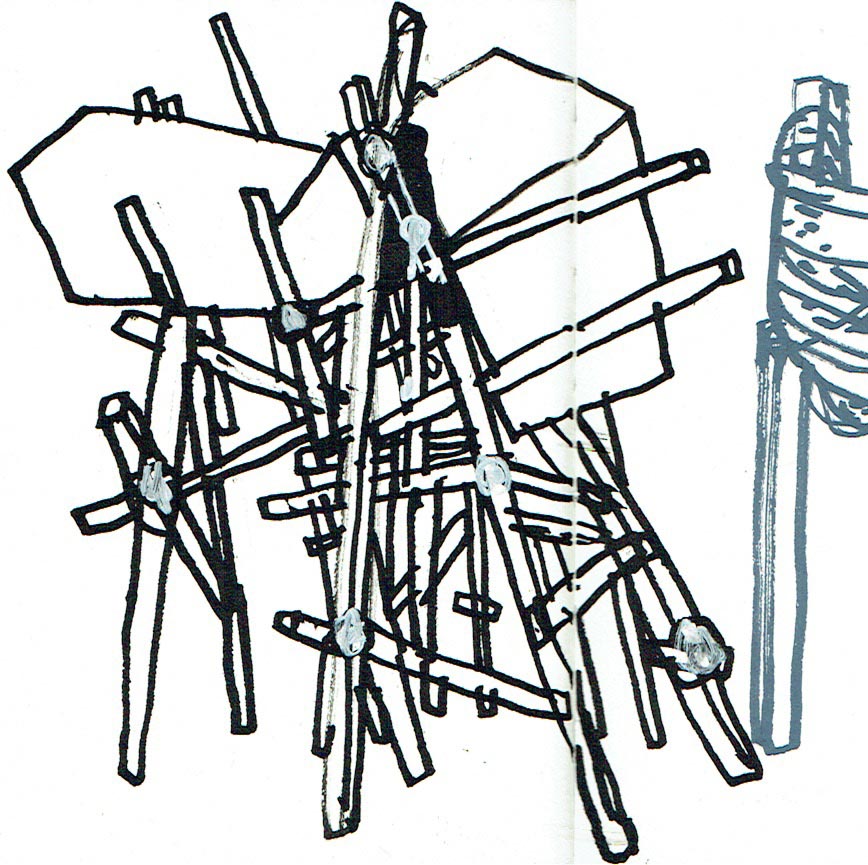
I've included some other drawings of works I've encountered at recent exhibitions:

Phyllida Barlow's untitled: blocksonstilts, 2018-19 at the Royal Academy in May 2019 (top image),


Cornelia Parker's Transitional Object (PsychoBarn) at the Royal Academy's courtyard in November 2018,


and Kader Attia's Untitled (Ghardaïa), 2009 (above), and Monica Sosnowska's Pavilion, 2016 (below), both at Tate Modern's Living Cities display in January 2020.


There are more of my drawings on Instagram.


Monday, 19 November 2018

On letting go


I've often thought that the process of drawing has similarities with the ups and downs of form experienced by sportspeople. Sometimes things flow effortly, and then at other times it can seem like hard work, when nothing goes as you'd hoped. I was reminded of this while reading On Cricket, a new book by the former England captain and psychoanalyst Mike Brearley. A passage in it refers to playfulness and losing inhibitions:

"... I think that writing, like playing cricket, like, in fact, many activities of life, involves at best a benign sort of marriage between discipline and spontaneity, between hard work and playfulness, between letting go of conscious control and the application of sometimes critical thought."


Of course, it doesn't always work out as you'd like. The playfulness can easily come unstuck. In terms of drawing, that is what sketchbooks can be for: an arena for coming unstuck and being spontaneous, and occasionally, sometimes (and not necessarily in the images included here) an uninhibited zone where you can happily surprise yourself, buoyed up by all that experience, hard work and discipline. And not mind whether they gather two likes on social media or two thousand.


From the top: the view from the top of Tate Modern looking towards Blackfriars Bridge, three scenes from a moving train going to the Midlands from London, and Cornelia Parker's Transitional Object (PsychoBarn) in the courtyard of the Royal Academy, London.