Showing posts with label hv morton. Show all posts

Wednesday, 6 January 2021

Caught in the rain on Dartmoor

This is the latest in a series of posts about my journey around England in a camper van in 1990. Read an introduction to this drawing journey around England here.

[Bracketed sections like this have been added in 2020.] 

At Tavistock, having loaded the van with food from Gateways and filled it with petrol, climbing the roads towards the moors became ever slower, and it was no surprise to find myself (and the ever present cortege) crawling into dense clouds. Once past the cattle grids it is a relief to be driving along hedgeless roads, except for the tendency of sheep and ponies to wander onto the road. On summer evenings especially they huddle together on the tarmac, which retains its warmth into the night.

It is cold and miserable turning in to Princetown (top image), the tors occasionally glimpsed through the mists. It is weather that suits the town well enough – it is remote and exposed with a sense of rising as well as falling damp. Down a walled road I get a first view of the prison for which Princetown is best known. 

["Mad" Frankie Fraser, the Acid Bath Murderer John Haigh, and Axeman John Mitchell were among its inmates. The prison is due to be closed in 2023 and – just possibly – turned into a hotel.]

There are yellow lines to stop parking by the prison's walls, but a coach has pulled in anyway by the gates, its occupants lurching over to one side to show a wall of faces against its windows. There isn't really so much of the prison to see except these great excluding walls and a barrier rising and falling for cars to enter a line of successive gates. But what there is transfixes. It is like looking at a dead body washed up on a shore; you don't really want to look but you know you must. These blank walls have added significance for being all there is to show for lives spent inside.

James Hobbs, Dartmoor Prison, Devon, 1990

The town would not be here without the prison. Built for US and French prisoners of war in the 19th century, the prison and the town itself have struggled to survive. To hold out against elemental forces that threaten to dissolve the very fabric of everything except the tors is almost enough. If Princetown was abandoned tomorrow, you would half expect all remnants of human habitation to be washed into the rivers and streams within months, devouring its past.

Prisoner officers come out in small groups to go to their sad-looking houses up the road. They are disgruntled and reluctant to talk. I have heard on the news that they are voting on taking industrial action today. A few months ago there were prisoners sitting on the roofs of prisons up and down the country, a phenomenon Dartmoor did not entirely escape, a lone figure being picked up by a photographer with a zoom lens from across the moors.

The prison is the town. Either you are trying to make a living in the prison or from the tourism it generates. Otherwise you are a tourist or one of the prisoners that are seen occasionally working out in the fields. The tourist office is empty enough, the man behind the counter startled by my entry. There are photographs of the moor's sunnier days, of streams that tinkle just to look at them, when the terrain is a release rather than a confinement. There is a map on the wall showing the old mining railways that used to run across the moors here.

James Hobbs, Dartmoor Prison, 1990

They are gentle walks now through a landscape it is easy to imagine as being unspoiled, but which are really scarred with the quarrying that has gone on over the years. Following one former line just out of the town, I found rabbits hopping around heaps of granite rubble and sheep as surprised as the man in the tourist office. It is hard to get lost with the TV mast perched over the town acting as a marker, but even this appears to move against the drifting clouds.


James Hobbs, abandoned granite blocks for London Bridge, 1990

Among the rubble, further around, are the shapes of twelve carved blocks prepared for the building of London Bridge in the 1890s, crooked but far from overgrown. Now they still sit by the rotting wooden sleepers that once held the track. It is the railway that has departed instead. A number went when London Bridge was sold and shipped off to Arizona and some repairs were necessary. It is just down to these dozen now, a bizarre but cheerful reminder of some madder world.

A woman by the road at Two Bridges is pointing out a farm where I could camp when a car speeds by with its hooter on, scattering a group of ponies that stood at the edge of the road. "No offence," she says, "but it is the youngsters that come out of the pubs at night and don't give a second thought – until they see the dent in the bonnet the next morning."

James Hobbs, Dartmoor, Devon, 1990

The farm she directs me to is down a track that leads to a small stone bridge among low trees. Pulled in on one side are a couple of long caravans, a lorry and an estate car. They look to be here to stay. A child stares at me through a window as I pass. The farmhouse is further on, the door open showing a messy, deserted kitchen. Two upturned buckets are on the floor and a pile of socks are on the table. I knock and shout, but nobody comes.

Walking back trough the yard they catch sight of me from one of the outhouses where they are watching a rejected calf being fed by another cow. A group of blond-haired children look on too with the young farmers and then we pretend to help by sealing off escape routes as the calf and cow are coaxed back into a field. They seem to know which way to go without our help.

Soon the farmers are telling me what tough land it is to farm, of how it takes social security and family credit to keep them solvent. They have a thousand acres, a huge size, "but it takes that much to keep it profitable up here," she says.

He is young and bearded, and she is a throwback to some sixties pop festival. I ask them if they dislike farming so much why they don't just sell up and go. "Firstly this isn't ours to sell – we're just Prince Charles' tenants – and secondly we are trying to get out," he says. "We work 90 hours a week and still rely on handouts – of course we're trying to move."

So I pay him the 50p they charge for a night camped by the river. On the water's edge are two tents owned by a nurse, his partner and a boy from a special needs school in Wales who skips around the field in a wide arc. They are as vague as he is energetic. In the evening we all go into a pub in Princetown in their Land Rover where I rattle around in the back with their two dogs.

I get on with camping by the river and use it as a base for a few days. I have neighbours who drop in from time to time for a chat. The children from the caravans, Holly, Megan and Luke, bring me a bunch of flowers. There are no toilets or showers, but it is cheap. Occasionally, fleetingly, it even stops raining.
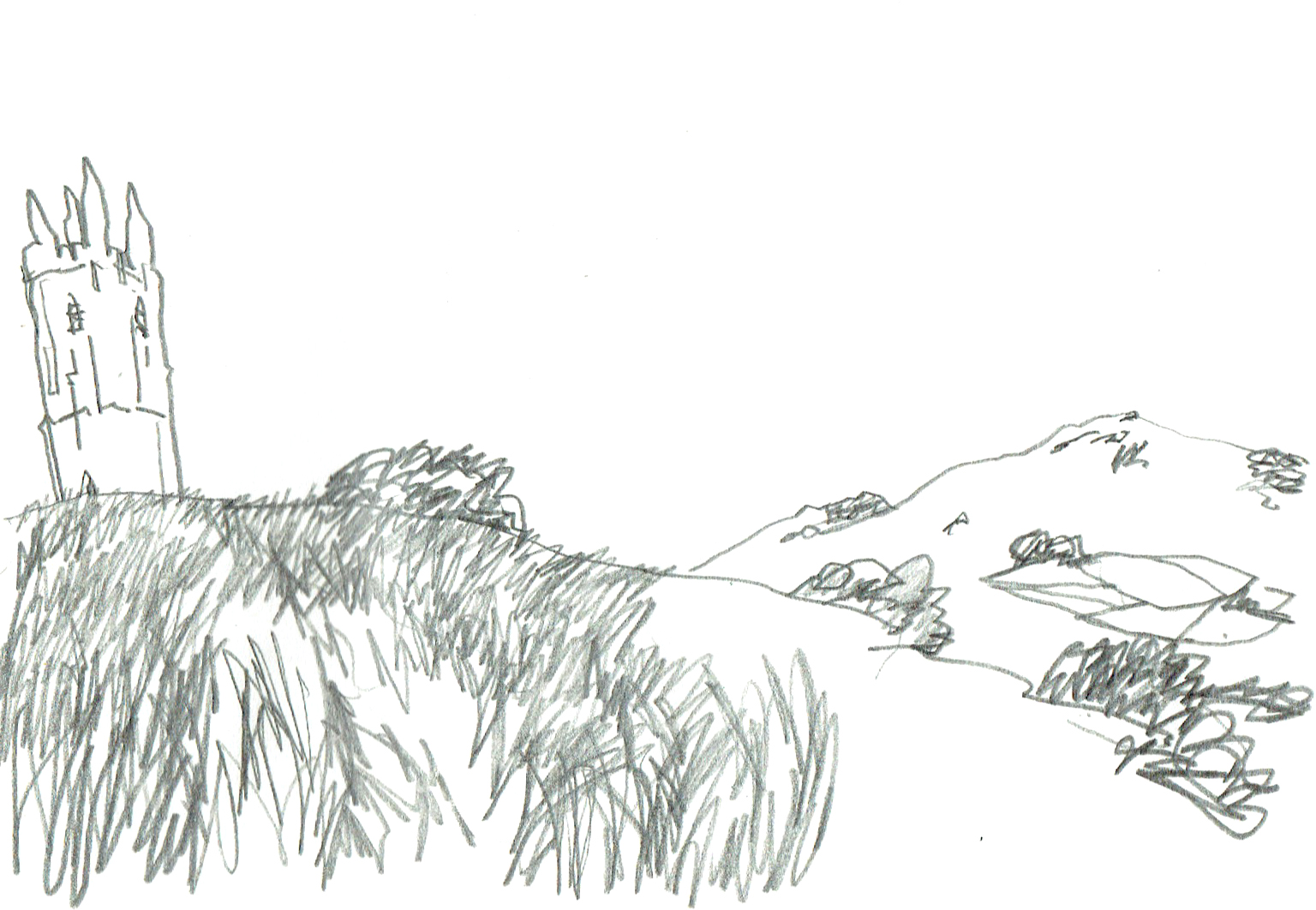
James Hobbs, Widecombe-in-the-Moor, Devon, 1990

After a visit to Widecombe-in-the-Moor I drop in at the Warren House Inn, a quiet place in the middle of nowhere. When Morton was here this pub had a fire that had burned for 100 years. It burns on as pathetically as when he was here. Two logs are perched on a thick bed of ash, only the odd spiralling fleck giving away that it is alight at all. The landlord admits it is almost impossible to let it go out.

"Sometimes we go out for the day, down to Plymouth or somewhere, and come back and it will be there looking dead and all you have to do is drop a couple of logs on and it's away again. No problem."

He'd never heard about In Search of England and so he reads about Morton's visit leaning on the bar while I sip my low alcohol cider. The old stuffed fox is gone (the landlord had disposed of one not so long ago) and there are the murmurs of conversation over the clinking of eating and drinking. That this pub is here at all is again thanks to the tinners who once worked nearby. Now it attracts hikers, salesmen and watchers of the useless fire.

Back at the campsite I cook in the van with the rain still falling, listening to Brazil beat Scotland in the World Cup on the radio. I leave the moor in the morning, nearly getting stuck in the muddy field and driving up the road to cheers and waves from the children. I stop in Princetown to do some shopping and take a last look at the prison going in and out of focus through the mist.

The van will not start when the moment comes for me to make my own Dartmoor escape. A man appears from nowhere with a can of WD40, which he sprays liberally around the electrics, and I am gone.


James Hobbs, 1990


James Hobbs, Clovelly, Devon, 1990

[Further posts about this trip will follow here soon. This is a link to details about my journey, which started 30 years ago in spring 1990. I'll be posting images from the trip on Instagram.] 


Friday, 21 August 2020

Through the lanes of Cornwall

This is the latest in a series of posts about my journey around England in a camper van in 1990. Read an introduction to this drawing journey around England here.

[Bracketed sections like this have been added in 2020.] 

I camped in a green lane last night, a narrow unsurfaced track that connected two even narrower roads. Up at a farm they tell me it will be quietness itself up there and that the only problem will be which gateway to park in, which view to have when the side door is swung open. I try each gateway for size, and pick on one that looks over the wheatfields to the tall tower of Probus church (above), its bells carrying on the wind this practice night.

Within minutes a motorcycle shoots by. In those few seconds we exchange startled glances, me with a kettle in my hand, him from beneath a blue peaked helmet before he's gone over the hill. By the time I have cooked another minor classic from my two saucepans and been for a walk around the fields he comes back and pulls up shaking his head.

“I’ll be sending a report about this to County Hall, yes I will. Built a shed right across the track further along they have, so you can hardly get by at all. Would you believe it?” There is more head shaking.

This is how he would spend his summer evenings, he tells me, going up and down the lanes on his bike. There is, he goes on, a danger that green lanes such as this are to have their status changed to footpath or bridleway, which would prevent entry to motor vehicles, such as his bike, few as they are that want to use them. His journey was a kind of modern beating of the bounds.

Just why this was so important to him he had trouble in explaining and I had trouble in understanding. In fact it was as if he'd never asked himself the question before.

“Now this shed is the sort of thing that will get these lanes closed to folks like me.”

“But," I dare to ask, “you say you only use it to make sure that you can still use it and that's the only time it really gets used by motor vehicles.”

He gives me a hurt kind of expression, but rallies.

“Ah,” he says, “but you have used it too.”

And with that, mercifully, he heads off.

James Hobbs, Bohortha, Cornwall, 1990


Roseland is a peninsula off a peninsula, a splinter of land off the south Cornish coast. Winding down the roads this morning, my pace having collected the usual trail of traffic behind me, I'll admit to being particularly keen to reach St Anthony-in-Roseland. Whereas Morton's enthusiasm for this little village had sprung from the magic of its name, mine was a matter more of seeing just how well the perfect idyll he had described had survived, how it had coped over the last 60 years, because in many ways it had the most to lose. There was an inkling that perhaps the sleepy, thatched village would have been adorned with bungalows, mini-markets and satellite dishes.

For a start, it is no easy place to find. There are no signs welcoming careful drivers to St Anthony's or brown signs to heritage centres. I had driven to Roseland's extremity, where the lighthouse sits, without uncovering it. My map omits all references and sitting looking across the tanker-strewn estuary to Falmouth I began to entertain the idea that the village he had described was nowhere to be found but in Morton’s own head. 

It is a landscape of hidden places, of glimpses of water in unlikely directions, of houses that disappear immediately the moment you pass. I start working my way back, turning up side lanes until I find what I think I am looking for: St Anthony is at the end of a no-through-road signposted Bohortha. If the village has a secret, it's going the right way about keeping it.

There is a bend in the lane lined with a few cottages before the road peters out into two grass tracks. It is all wonderfully unexceptional, so much so I need convincing it is the village Morton wrote about. For the first time I have to get out In Search of England to try to piece together whether I am in the right place; there is a little surviving thatch weighed down by tarpaulins and ropes, a farmhouse and the old school, already closed by the 1920s when Morton came.

A woman comes down the road wearing a floppy camouflage hat and carrying a basketful of strawberries. She introduces herself as Betty, and at just the mention of Morton, I know I have arrived.

“We do have a few people around asking after him. He stayed up at the farm around the corner there, where he sat and listened to the wireless. But his chauffeur stayed at Pink Cottage,” and she points to the house we are standing right outside. 

Chauffeur? This is certainly news to me. Having scoured his book countless times, I have found no evidence to point towards a chauffeur whizzing him around the lanes, and I don't like the sound of it too much. While I have been rattling up and down the coast using hedges for a toilet, he was sauntering from, perhaps, hotel to hotel in the back seat of a car trying to act the part of an intrepid explorer. He waxes so lyrically about the virginal simplicity of his room at the farmhouse, it does suggest it is something of a unusual change for him. But a driver? I can hardly believe how he could have kept it from his readers if it had been the case. [We know now from Michael Bartholomew’s book In Search of HV Morton that Morton was hiding much more heinous truths.]

The cottage is thatchless with dull paint and frosted glass in the front door, a holiday home. [It now seems to be available to rent.] There is an old water-pump in the garden. A vicar in Bath owns it, Betty tells me. A thick airport novel is inside on the window sill. It is a cottage with a glazed expression waiting for visitors.

This is the closest I have been to Morton since I left and I wonder if there is anyone who would remember him, unlikely as that may be.

“My father would have met him,” Betty tells me, promisingly. She pauses. “But he died 30 years ago.”

For all thesigns of a fairly timeless way of life, there have been changes here. Like when the defences for the war were built out on the Point, and when mains electricity arrived in 1945. Mains water waited until 1963. But there's no public telephone and no shop, and Betty didn't know anyone with satellite television. Instead there is the silence and wind of an island, its remoteness interrupted by a white milestone outside a house.

“London 272 miles.”

It had been put there by the owners of the house as a joke for their visiting friends, but now it is little more than a rude intrusion. London seems further away than that.

James Hobbs, Place Creek, Roseland, 1990


There is a church, but it is away across the fields behind the manor. The route leads over a hill, the grass thick and green with smells of dampness and scents of hedgerow flowers. The path splits and follows on under overhanging branches of trees along the edge of a cornfield.

The tower of the church only becomes visible through the trees when you are nearly on it, but it is wrapped in red campion, white leeks, rhododendron and roses. At least, this is what I am assured they are by a woman gradually sniffing and poking her way around the paths. On either side are steep banks of trees that threaten to swamp the scene with even more foliage than there is already. 

Birds swoop low over my head as I enter the dark church. You make an involuntary effort at ducking in these circumstances, but by the time you do they are well past anyway. The interior has not, I find when my eyes grow accustomed to the dimness, fared well under a regime of neglect. Plaster has fallen from the ceiling, the altar is stripped bare and paint is blistering and bubbling from the walls. Only the windows and memorials to those from the manor next door give the impression that any care has been taken at all. A stack of dishevelled, damp hymn books suggest that the Occasional Services notice is something of an overstatement. 

A man passing outside can help me with this. It started as a question as to when the next service might be and ended in the story of a village. Soon he was slumped next to me on a bench telling a long tale of animosity between the manor, who had kept the church in repair since 1650, and the local diocese.

“The manor had spent £7,000 on lead for the roof and £4,000 on the windows and then the vicar, strange man, refused to come out for a wedding and the next thing, before you know it, one thing has led to another... Normally I would be the one to come and give the graveyard a strim, but now I only feel embarrassed about it and I don't like to have to explain why it's in the state it is. You can almost see it being demolished... You're not a journalist are you?”

The most polished and quaint of rural scenes are all too easily taken to be a reflection of the tranquillity and equanimity of life in the country, so to find the relative worldliness of this situation is like catching the village with its trousers down.


James Hobbs, St Just-in-Roseland, Cornwall, 1990


It is a Sunday morning at St Just-in-Roseland at five minutes to eight and the church bell is ringing. I have slept in a corner of its car park and heard the clock striking each hour through the night. As the cars begin to surround me, I get dressed and watch the churchgoers on the walk through the gardens, following the trail of umbrellas. 

The care and attention that has been given to this church is a mirror image to to that I had seen bestowed upon St Anthony's yesterday. Heading through the tropical vegetation (a memorial to the eccentricities of successive clergymen who have devoted themselves to it), weaving between palm trees and ponds, I can imagine us for a moment as a group of expatriates making our way through some outpost of the Empire. Someone shouts, “But Dorothy, how frightful!” without a trace of a Cornish burr. Watching the little crocodile of elderly congregation disappearing towards the tower set against a creek, I half expected them to be gradually picked off by sniper fire from the rear.

Trekking back to their cars afterwards, the creek is revealing acres of mud through the ebbing tide. There are fallen trees from the winter's storms and a £10,000 appeal for them to be cleared by floating them down the river. Later an American contingent arrive with their camcorders. They avoid the sight of an oil rig moored in the estuary around the corner, a bizarre vision in the circumstances.

James Hobbs, Oil rig, Cornwall, 1990


A woman is working in her garden overlooking it, but I have trouble in making myself heard in the wind.

“Excuse me,” I try again, “could you tell me about the oil rig?” She continues to struggle with a support for a flopping plant, shoving and hammering with no sign of a reaction.

“Hello!” I shout this time. Still nothing. She is evidently as deaf as the post she is now beating into the ground with an axehead, so I leave her to it. I can only assume the oil rig is not a permanent feature.

James Hobbs, 1990

Read on: Rock bottom at Land's End 


Thursday, 25 June 2020

Leeds go mad in Dorset


This is the latest in a series of posts about my journey around England in a camper van in 1990. Read an introduction to this drawing journey around England here. 

[Bracketed sections like this have been added in 2020.]  

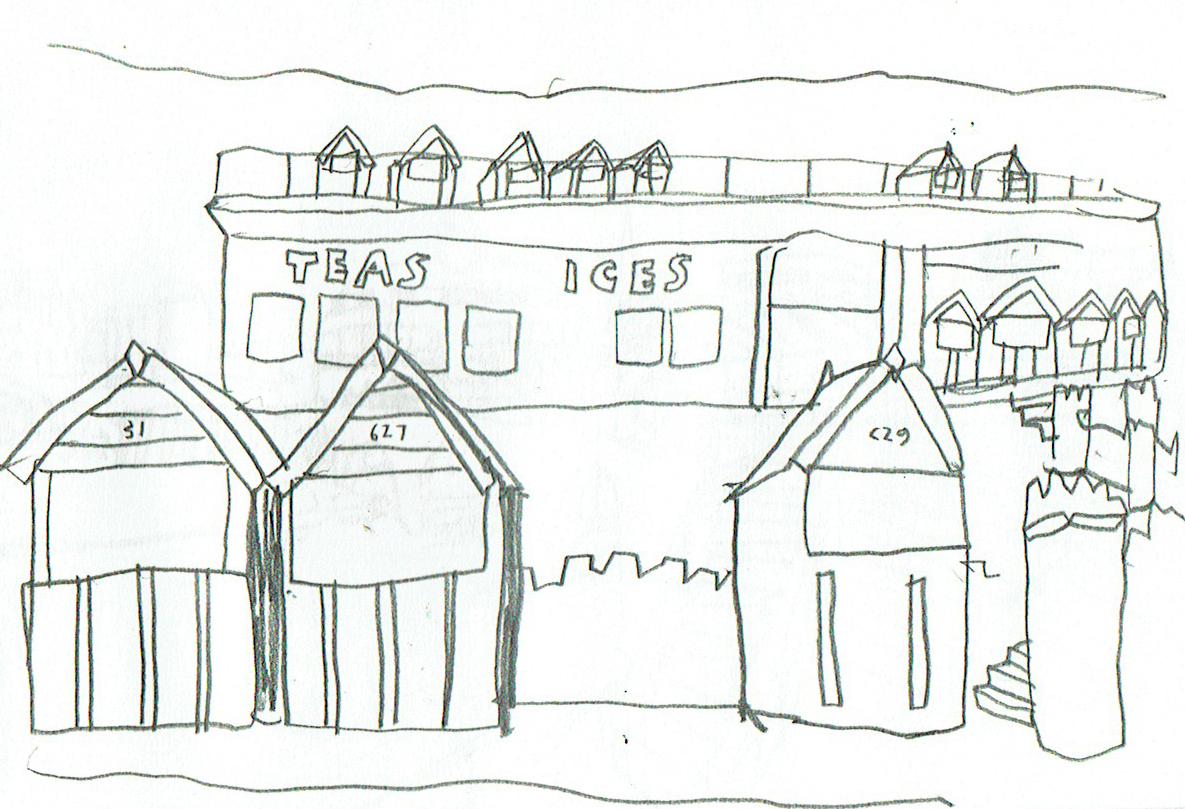
It's May Day Bank Holiday weekend in Bournemouth, 25C and queues of cars are edging open-windowed or roofless towards the seafront where the beach is already packed. It is the fulfilment of all those winter yearnings for a tan. The most unlikely looking windows are being used to sell refreshments from, but the busiest and loudest is a pub near the pier from which comes chanting and a sort of singing.


I had parked under the shade of trees at Branscombe further up the coast, once, and not so very long ago, a separate town but now congealing like the rest of the south coast into one long line of development. It is easy to see on a day like this how Bournemouth could have become so popular in the last 200 years: long sandy beaches, pine trees, and green, south-facing cliffs. The traditional and familiar attractions of days out at the seaside seem to be alive and well: there are the smells of fish and chips and sun lotion, a Punch and Judy tent, waterskiers, acres of pale bodies, family arguments and amusement arcades, all these, but with sun too.


But sun and alcohol are not mixing too well at the pub by the pier (top image). Today is the last day of the football season and the visitors, Leeds United, are expecting to get promotion into the first division [the Premier League was launched in the 1992-93 season] at the expense of Bournemouth Town, and to this end they have set about trashing the place. 

Apart from the drinkers, who are watched by groups of police, there is a larger and yet more ugly gathering further on by the beach. It could be 1,500, it could be 2,000, but they are a mass of young men that seem to have come from just a handful of moulds. Short haired, T-shirted, wearing shorts or jeans, holding cans of alcohol that are crushed and discarded on the pavement as quickly as they are emptied, they are seething, singing, chanting, kicking footballs high into the air so that three or four of them keep popping up as they gather for the march up to the ground for the game.


I cannot take my eyes off this sight. It is almost like an old circus sideshow where those with hideous deformities are paraded for the public. This crowd is ugliness itself, unlike anything I have seen before, a bundle of fascism and bigotry I gather from the songs they are singing. It is frighteningly magnetic to watch. As a group they are all of a single mind, and not a very broad one.


[This weekend of violence by Leeds fans in Bournemouth grabbed the headlines in a way I didn’t really recognise at the time. I didn't even draw the fans, for instance. There were more than 100 arrests and 12 police were seriously injured over the weekend I was in Bournemouth. There were even questions in Parliament about the violence that unfolded.] 

The Bournemouth Evening Echo has not missed out. “Thugs on Rampage” runs the headline above stories from the night before. Beach huts have been set alight. In the town centre windows are boarded up, some in anticipation, others evidently repairing what has gone before. Mounted police roam the pedestrianised centre while fans wearing “Bournemouth Invasion” shirts pose for souvenir photographs next to them.


Just to get into a supermarket is not easy, the way in barred by a policeman. I first have to convince him that it is food I want to buy rather than anything alcoholic. There are more police inside roaming around the aisles. They call everyone “lad”, trying to defuse the tension with a forced good humour.


For no apparent reason, the crowd by the beach takes it upon itself that it is time to leave for the walk to the ground, and, as one, it makes off leaving the debris that until then it has been impossible to see. The shouts and singing seem to hang in the air long after they have all leaked away up the road.


What surprises me is just how prepared people are to accept that this is the way things must be, to go on regardless as if this ugly violence is entirely normal. Half naked women push their way through the fringes of the fans to join the queue for ice creams, going barefoot through the empty beer cans littered around as if it was the most normal thing in the world. Police stand around to almost heighten the crowd's sense of importance, a sign of the fans’ power to disrupt, acting as escorts to a roving lawless zone. A camouflaged military vehicle I associate with the streets of Belfast looks on. I am amazed that a kick around between two teams of eleven can be worth all this.

James Hobbs, Bournemouth sea front, 1990


The more usual beach noises return as kick off approaches. Some of those without tickets turn on radios to listen to the commentary so that they overlap across the sands, never out of earshot. The air is freed from sirens for a while but it is replaced by racist chants from groups draped in Union Jacks who troop up and down the beach looking for topless sunbathers.


We hear the game won by the Leeds team down on the beach, looking out to the still sea that few people actually bring themselves to swim in. The sight of a large offshore structure for drilling oil must be as responsible for this as anything. I plan to get well out of town for the night before the ground empties and the Leeds celebrations begin. I am well up a very deserted country lane before the late kick-off results come over the radio.


Two days later and the wind and rain are back, the deserted beaches marked by tractor tyres where the sand has been raked and cleaned. The flashing orange lights of council cleaning lorries have taken over from the blue ones of Saturday’s police cars. A few people are about. There is a children’s roundabout in the shape of a teapot around which seated toddlers turn in teacups at the end of which they head with their carers, like me, to the domed cafe on the pier. 

James Hobbs, Happyland Amusements, Bournemouth, 1990


It is more likely to be like this when you visit Bournemouth, you and a few others wondering where everybody else is. An elderly lady strolls in the gardens to the relaxing cry of seagulls, leaning on her only slightly younger companion, enjoying the flowerbeds and pointing her walking stick at shrubs. I pass just in time to hear her lean towards her friend and say: “You know Mrs Thatcher looked a picture in the paper today...” Bournemouth is back to its old self. 

James Hobbs, 1990 

[Further posts about this journey will follow here soon. This is a link to details about my journey, which started 30 years ago.] 


Thursday, 18 June 2020

From Romsey Abbey to Southampton docks


This is the latest in a series of posts about my journey around England in a camper van in 1990. Read an introduction to this drawing journey around England here.

[Bracketed sections like this have been added in 2020.] 

Knocking at an old farmhouse near Romsey, I’m told by a correct, middle-aged woman that I can park overnight in the track to their house but that her husband will be back soon and will want to meet me. The temptation is to say that I only want to camp overnight rather than marry their daughter, but by the time I’ve put the roof up he has swung around the corner in his Range Rover and stopped by the back of the van.

Touring vans have not had the best of publicity around the south of England recently and, apart from the running battles with travellers around Stonehenge at summer solstice time, there are farmers who have resorted to court injunctions to move on unwelcome convoys, and outbursts to local papers on the subject of the damage they were left with. A solitary van is often seen as the thin end of the wedge by landowners – let one in and more will follow – which is probably why the husband is now bearing down on me as if I had pitched camp in the middle of his croquet lawn.

I get out to meet him halfway, surprise him by shaking his hand and try to persuade him I am not someone he ought to be moving on. I summon all my efforts into coming across as respectable as I can be, and he calms before too many blood vessels are burst. I know I have made a reasonable impression when he comes out to see me again later while I’m washing up to invite me in to the house for coffee and a glass of port. “We don’t like to think of you up here on your own,” he says.

Soon I am sitting in a huge wheel-backed chair with a cat on my lap, glass of port in hand, listening to their worries about their daughter’s boyfriend, who has just arrived to take her off to a party to the sounds of much wheel spinning in the drive.

This is still commuter heartland. He is a solicitor dividing his time between London, Bristol and New York. She fusses around him, a woman apparently given to Good Works. The kitchen’s working surfaces are as clean as an operating table. There are three cars lined up in the drive.

We chat about Romsey (top image) and Lord Mountbatten of Burma, who lived in Broadlands on the edge of the town until he was blown up by IRA terrorists on his yacht in 1979. You can’t be in Romsey for too long before his name crops up. He was obviously very popular here and could be found occasionally drinking in the town’s pubs and getting up to the sort of thing that goes down well with the locals.

“The whole town went into mourning when he died,” the husband said, leaning against the Aga, “and there were these great public shows of grief. So much so that the shopkeepers all had black window displays as a sign of respect.” They laugh at the thought of something that occurs to them both at the same time. “Even the lingerie shop got involved – they filled their windows with black underwear.”


Leaving early in the morning – the night only disturbed by the daughter arriving home in the early hours as I am unburdening myself of too many cups of filter coffee, momentarily flashing my shadow across the farmhouse wall – I head up into the town.

James Hobbs, Market Square, Palmerston statue, Romsey, 1990


In the market place it is a surprise to find that rather than Mountbatten it is a statue of Lord Palmerston, twice prime minister, whose family had previously owned Broadlands, that gazes out over the square. On the corner of one building hangs a bracket that was used to hang Cromwellians in 1642. The building now houses the local Conservative club, in which there is a lot of activity.

[The statue of Palmerston – who favoured the abolition of slavery – seems safe from toppling during this time of scrutiny of the UK's historic and current racism.]


Romsey Abbey is a thing of beauty and certainly a bargain at £100, the price paid by the town when it was sold at the Dissolution, even at index-linked prices. Inside there is time to see the Anglo-Saxon rood screen and the rather gruesome tress of hair found in a Saxon coffin, but, talking to a helper in the Abbey it isn’t long before she too gets around to Mountbatten. He is still a great unifying force in the town. There is a large stone to his memory inside.

James Hobbs, Romsey Abbey, 1990


She directs me down to a bridge on the way out of town where you can get a good view of Broadlands, the large porticoed house where he lived. It will be open to the public later in the day, but for now I have to make do with the view photographers with long lenses had when Charles and Diana spent their honeymoon here in 1981.


When I reached the bridge there was every reason to suppose she’d been pulling my leg, because no large mansion was visible. An elderly man walking his dog stopped to help me.

“Come down this way and you’ll see it – I’ve spent hours here myself painting it,” and he leads me further down. His surprise is apparent when he too can see nothing of it through the bluish morning haze into the sun. It is as if it has disappeared.

“You know,” he says, “it used to be there.”


*****

James Hobbs, Southampton docks, 1990

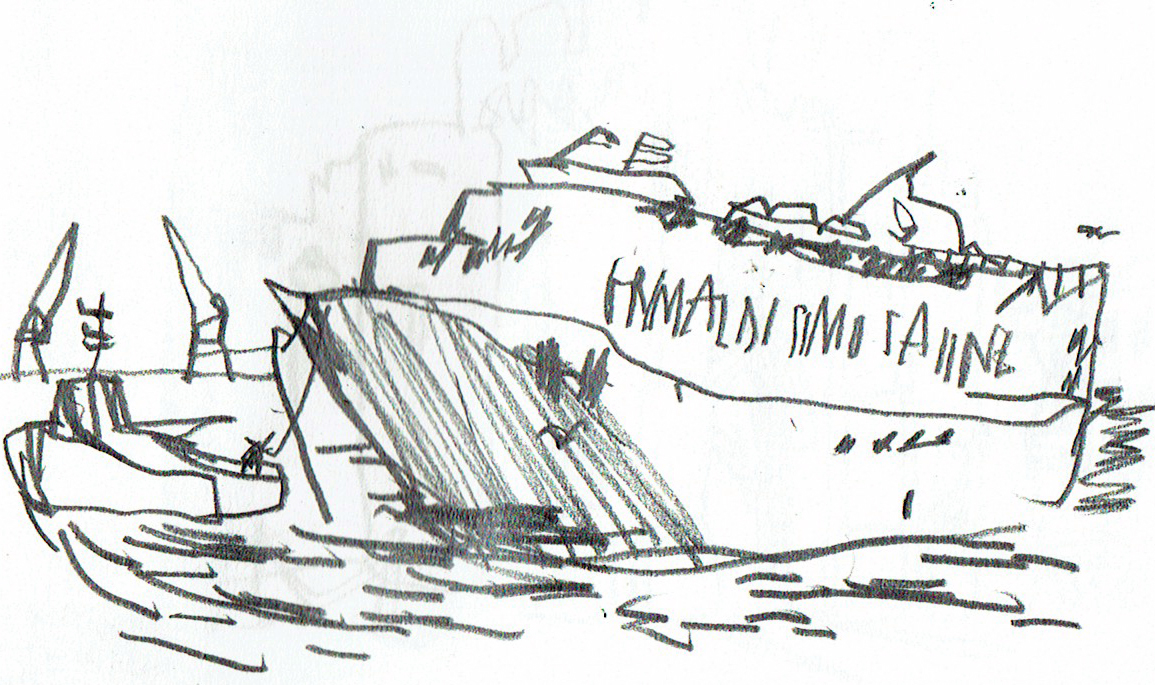
Southampton is almost like Istanbul from the docks, if less busy. People are on their way down to the ferry to cross the water to Hythe from which chimneys puncture the sky like minarets. “Come Dancing” a battered sign announces from the next pier, a warm welcome from a tangled mess of girders and barbed wire. There is peeling paint and high fences, no unauthorised entry. It would be an eyesore in many places but here it can almost be overlooked. Cranes are everywhere and there is the great container port further up. There is little traffic today apart from a tug and a vast tanker.

The ferry is about to leave, and confusing its destination of Hythe with Ryde on the Isle of Wight, I quickly get a ticket and jump on board. Instead of the Isle of Wight I get a quick trip across Southampton Water and back. It is less momentous than other voyages that have started out from here. For 500 years it was one of the country’s leading ports, with massive city defences facing out to sea. Ships left from here for the Napoleonic wars, the Mayflower in 1620 before stopping off at Plymouth, and going into passenger transport in a yet bigger way at the beginning of this century, the White Star and Cunard Lines ran from here.

So a short trip on a ferry is a token gesture even if I did get back almost before I’d left. On board there are bicycles stacked, and work suits and ties have been discarded for shorts and trainers for the ride home to the far bank. Its passengers sit with the resignation that comes from commuting, but there is the sun, a cool breeze and even the occasional shower of spray, a class above your average ride home on the underground. Most sit inside to shelter from it, locked into books or personal stereos. I am reminded of a ferry ride up the Bosporus when shortly after leaving Istanbul a young man moved among the packed benches taking off his artificial limbs one by one waving them above his head in an attempt to collect money. I wonder here if they would even raise their eyes from their books. 


Everyone gets out at Hythe’s long pier except me, and nobody boards except the ticket collector’s granddaughter, who he chases around the deck. We, meanwhile, chase the real Isle of Wight ferry as it returns to Southampton. Ocean Village is a part of the waterfront with a typically 1980s look, a new development packaged as a place to be seen flaunting boom-time spoils. It’s like a scene from the Boat Show, except here it goes on all year. There are shops and bars to go along the jetties, a scene of conspicuous consumption that was built as a playground for those riding high on a succession of tax cuts.


But the tax cuts could never go on forever and it is as if the party is moving on to somewhere else now. Things are evidently not so easy. Among the trendy cocktail bars near Canute’s Pavilion are the empty shells of shops and ‘To Let’ notices that have been left by the receding economic tide.

James Hobbs, Southampton docks, 1990

Less conspicuous and more enduring is the sight of a couple come to sit in the sun by the old "Come Dancing" pier - eyes closed, faces looking up, ample white flesh on show where clothing has been peeled back to feel the warmth. Another tanker passes down Southampton Water. Children eat ice creams rocking forwards and back on their bicycles while a dog sniffs around them.


At the bank to get some money before I leave, the cash machine gobbles up my card and slides its cover abruptly over the keys. The bank is shut and I have this horrible feeling it could be weeks yet before a new bank card finally catches up with me.

James Hobbs, 1990

Read on: Football violence in Bournemouth


Wednesday, 27 May 2020

Return to Winchester


Read an introduction to my drawing journey around England, which started 30 years ago.

[Bracketed sections like this have been added in 2020.] 

So I reach Winchester, which the guide books will tell you is a beautiful city stocked up with no end of history, how it used to be the capital city and one of the most important cities in Europe. But I haven't looked forward to it. I lived in Winchester for three years when I was at art school so I am well used to a dreary respectability that lurks beneath the surface. It is a city that spends the evening watching Terry and June repeats or is tucked up in bed by nine in the evening with the Daily Telegraph crossword.

[In retrospect, I seem a bit tough on Winchester here. It’s probably moved on a bit since then.]

But I arrive on different terms today, to stay a couple of nights and see it from what I hope to be a better perspective. There is no denying it is a beautiful place once you escape the one-way system that loops around the centre with its share shops and wine bars. I leave the van by the park and walk in.

It is a gentle and restrained city but rather like someone who has outgrown their clothes; it is more like a town with the historical trappings of a city. The cathedral sits like a ship run aground, left high and dry as the city's importance as one time capital of England has ebbed about it.

Winchester is probably still recovering. Although there are Iron Age settlements nearby, it was developed by the Romans who laid out a grid system of streets and built its defensive wall. By the seventh century the Saxons had founded its first cathedral and St Swithun became its most famous bishop. King Alfred came here to live and made it his capital. And from then until the 12th century Winchester swung. Edward the Confessor was crowned here, William the Conqueror rebuilt the royal palace and the Domesday Book was written here. Thanks to records written at the time more is known about Winchester than any other city in the Middle Ages. It was stuffed full of traders from all over Europe, densely populated for its time, the second largest town in England.

You can get a sense that it hasn't all been downhill since from a walk down its High Street (top image). The shops are smart and expensive. Where there are gaps, shoppers can see through windows in the hoardings to where teams of archaeologists are sifting through remains before builders and concrete take over.

Winchester survived its loss of power and wealth to London, the Black Death (that left it with fields and orchards within the city walls), and the Civil War. Later the coming of the railway helped revitalise it: what had once been the nation's centre had become little more than a market town until the trains arrived. And it saves it still, in a sense. An hour from Waterloo on the train, it is the perfect retreat for people working in the City and wanting to escape to a home in peace and tranquility. Winchester is not a playground; the only cinema has been demolished to make way for more housing for the elderly.

A bearded man with a rucksack accosts me for money so he can get a bus to his family in Southampton. It becomes a familiar story. He greets me cheerfully later when I bump into him in a cafe. He seems wonderfully out of place here and tells me which bench by the cathedral an old lady goes to sit to offer her services as a self-appointed sexologist. At times it seems like nobody more than stockbrokers and retired wing-commanders live here so it is a relief to see this hint of a more quirky side of life.

James Hobbs, Cheyney Court, Winchester, 1990

The cathedral's spireless tower gives it an incomplete look and yet it still manages to dominate the skyline. Its first tower fell down in 1107. Having one of the longest naves in the country, it effectively cuts the city in two, keeping Winchester College and the water meadows apart from the rest of the town. In the summer the Cathedral Close livens up as people strip off to eat their sandwiches around the gravestones. Today they are taking cover by the west door, waiting for a shower to end on their way back from communion.

A walk down the south transept can be a disorientating experience as arches lean and the tiled floor undulates. Suddenly it is an uphill walk. The trouble is caused by the flood plain on which it was built, the River Itchen having rotted the wooden foundations to such an extent that in places nothing is either horizontal or vertical. By the lady chapel is a statue of William Walker, the man who worked underwater to secure the foundations at the beginning of the [20th] century, showing him in full diving gear, his hands outstretched, palms up.

What have also survived in a less than perfect state are the bones of an array of Saxon kings perched in boxes along the top of the side screens. Each contains a haphazard cocktail of regal remains now, their contents having been scattered around by Cromwell's troops on one of his visits. We can only assume that one king's bones look pretty much like another's and they were swept back into these boxes as they were found. Further along the aisle is a memorial to Jane Austen who came to live in Winchester to be close to her doctor. Sadly it wasn't close enough and she died soon after in a house nearby.

The streets in the afternoon become busier with the boys from the college going with their parents for tea, couples ambling down the pedestrianised High Street window shopping, walking off the Sunday lunch. Even the few punks Winchester has to offer seem as respectable as the city expects. Some sit with their dog around the Butter Cross, which stands awkwardly close to a bakery with a traffic cone perched high on one of its spires.

James Hobbs, Butter Cross, Winchester, 1990

A walk down by the water meadows is a popular thing to do on a Sunday afternoon. Homesick little boys in suits are taking awkward strolls with parents past the cricket pitches, and happier-looking, scruffier boys peer into the river from bridges looking for trout. The meadows are remarkably unspoiled despite being so near to the city centre. A dual-carriageway snakes around the foot of St Catherine's Hill, the footpath to its summit passing beneath it. It's a steep climb that leaves me puffing. At its top there is a maze, the old Iron Age fort, and a wonderful view over the city.

For a city that has experienced such turmoil and fervour down its historic past, Winchester has earned a breather now. Those who still like to think of England as being a gentle, sleepy place brimming with royalty and history could only find it delightful. I'm just glad I don't have to live here anymore. To me it is a place that time has left behind, not somewhere I would want to live, but perfect for a day out as a retreat from a truer more real world. 

The next day, having camped in a pull-in high up in the fields out of the city, fields famed for their corn circles that will no doubt appear later in the summer, and among the stacked and numbered trunks of trees sliced down by the hurricane in 1987, I set out for the church of St Cross. Down a lane towards the water meadows and through an arched gateway there is a large quadrangle bordered by the houses of the men who live at the Hospital of St Cross. It was founded in 1136 to house 13 poor men and provide free dinners for 100 others, and a few of its present inhabitants are sitting on benches in the sun looking towards the church. Besides the three rooms that make up their quarters, there are the old kitchen, a dining room and a hall adjoining the gatehouse.

James Hobbs, St Cross, Winchester, 1990

The church is beautifully proportioned and simple, and built at a time when Norman was (my guide book tells me) becoming Early English. Its quiet expanses of stone, wood and glass accentuate corners of activity. “Bird Beak Window” a sign says. Above it is the carved zig-zag arch and 500-year-old glass.

Along the back pew the May edition of the parish magazine has been sorted into piles fastened with elastic bands; Mrs Giles - 5, Miss Stanwyck - 9, and the visitors book left open. There is the mystifying nationality column, and then a comments section.
Parents married here in 1912.
Peaceful.
Norman? (This sounds like an attempt to communicate with the dead.)
Damp!
Kick out the darkness and let the light bleed in.

There is, as Morton would have said, a book to be written about the comments made in church visitors books.

The Wayfarers' Dole, the bread and ale handed out to travellers who demand it from the gatehouse, does not show the same unchanging qualities as the Hospital. Seven hundred years of generosity has resulted in a corner of a white Mothers' Pride loaf and a token sample from a plastic bottle of Webster's Yorkshire Bitter, both served with badly worn charity. A man serves it with the resigned air of one who has been through this a thousand times.

In Morton's time there was always a steady stream of wanderers stopping here for refreshment, the vagrancy laws keeping the homeless on the move between towns. Now the homeless are more static in city doorways or wandering the streets asking for change, and rarely seen on the grass verges of main roads. Tourists who have read Morton's book are the ones most likely to ask for it now, the porter tells me.

Taking the wooden platter and small earthenware goblet to a bench in the sun I can only hope they have not come too far for this. The hungry are better off heading straight to the pub on the corner by the main road where a more satisfying lunch can be found.

James Hobbs, 1990

Read on: Romsey, Hampshire, and Southampton docks

See more of my drawings on Instagram.

Wednesday, 29 April 2020

Bucklebury, Combe Gibbet and the RAC

James Hobbs, Bucklebury, Berkshire, 1990

Read an introduction to my drawing journey around England, which started 30 years ago

[Bracketed sections like this have been added in 2020.] 

The first night out. I have ducked off the A4 down a narrow road that, by the speed they are going, is well known by the commuters rushing home. I get the idea that the van and I are a rude intrusion into their well-ordered lives, getting under their feet. I dawdle along in the same direction, trying to find the village of Bucklebury: it is spread thinly through the lanes, and I never know quite if or when I have found it.

In looking for places to camp each night I am going to avoid the camp sites whenever I can and knock on peoples' doors to see if they can direct me to some quiet corner, and at least give England's reticent population the chance to say something to me and save money into the bargain. I have driven miles searching for the right sort of place when I come across a large white house at the end of an intimidating gravel drive that I select as my first target for somewhere to stay.

The door flies open to reveal a man in plus-fours and a mobile phone hanging from a belt like a revolver. A lean, elderly, military looking man, barks over to me, "What can I do for you m'boy?" in a colonial sort of way. I tell him what I'm doing and how I am looking for somewhere I can pull in for the night, words I was to repeat hundreds of times over the months.

"Morton! Aha, of course! My father had a bookshelf full! Never did get around to reading any myself."

But he leads me to a small gate down one side of the garden, which goes into a narrow field where I can stop for the night. He leads me past firewood stacked against a hedge to show me where I can park. The pile, he says, has not gone down over the past mild winter - "but it's a dreadful frost valley down here. Down to minus ten last week."

Expressing surprise here was a mistake on my part, and he jumped as if he'd caught me out.

"Towny! You're a towny! Only a towny wouldn't know it's been so bad!"

The sky is ominously clear, and I feel I am about to find it out tonight.

I heat a tin of soup and then follow the footpath that leads through the field to a horse-smelling criss-cross of tracks behind the hedges. There is a leafy wood that muffles the footsteps and every other sound, the acoustics of the English jungle.

But it isn't as silent as it seems. Over the birdsong is the white noise of the M4 and a ceaseless rumble of Heathrow traffic, two inescapable links with another pace of life. Coming back out of the fields as darkness falls I pass a line of bungalows that look over to the woods and click, click, click, their security lights come on one by one.

James Hobbs, Bucklebury Church, 1990

In the morning, my host is up in time to chat with me while the toast burns, painting a vivid picture of the whole of the south of England being overrun with deer, stripping trees of their bark as they go. He's really got it in for me now.

"If you'd been up at a decent time this morning, your..." he points at the van, struggling for the right word, "thing would have been surrounded by them. No education!" he concludes.

I offer him a cup of tea, but he has, after all, not yet concluded, and turned instead to his views on letting the starving of the third world die out naturally rather than being "mollycoddled" by the likes of "us". "Thinning out" he called it.

He waves me off, and I think he will miss me being around to shout at. I stop to draw in a gateway on the way to Bucklebury Church, listening to a cuckoo somewhere across the valley while a stack of pornographic magazines blow around the road. The church is hemmed in between the rectory and post office, now The Old Rectory and The Old Post Office. This is ideal commuting country, encouraged by all those country living articles in the colour supplements. The migration of rich and poor between city and country continues. It seems quite possible though that one day there will be no such thing as a "local".

*****

Even if you are driving around the lanes of Berkshire looking for a gibbet on a hill, it still comes as something of a surprise when you finally come across it. And today probably more so, as, chugging up the hill towards Combe Gibbet, I can make out the unmistakable form of a figure hanging from it.

James Hobbs, Combe Gibbet, Berkshire, 1990

From the twinkling lights reflected from car windows parked on the hill on this hazy warming morning, there is evidently a crowd out to see it. I have never considered myself an ambulance chaser but there is an allure to this macabre sight, and one I can't resist.

Getting closer, leaving the car park and its drowsy occupants with their BBC Radio 3 and vacuum flasks, I can see they are not concerned with the gibbet at all but giving their attention to group of grounded hang-gliders in the next field.

"'Not enough wind, just not enough,"' a helmeted man is saying. He turns to the little group and just for a moment I get the idea he's going to ask us all to blow.

The limp legs hanging from the huge T-shaped gibbet are way out of reach, but a soft stuffing is still visible oozing from one of the trouser-legs. The jacket is packed so tight that the few buttons that are left are popping off. The head is of stuffed sacking. It droops weightily, the noose giving it that same jerked angle you see in old black and white photographs from the hanging heydays.

On the opposite arm of the T, a sign has been hooked, awkwardly written, weathered and calling for good neck muscles and eyesight.
I am a farm worker who earns £120 a week. My rent is £30 a week, food for my wife and I is £60 a week. This leaves me £30 a week for clothes, transport, furniture and all the other things in life. I cannot afford a holiday. How can I afford £4 a week for our poll tax. This is the only way out. Please help to change this unfair system.
[The poll tax or, as the then prime minister Margaret Thatcher insisted on calling it, community charge, was a flat-rate tax that fell disproportionately on the poor. Her insistence on its implementation helped bring her down later in 1990. I came across a few other poll tax demonstrations on the tour.]

As a site for such a protest, you had to hand it to him. How can you resist such an apparition visible across half of Berkshire? The gallow's uses are now certainly few, but the farm nearby is obliged to maintain it in the condition it was in when it was erected to hang two child murderers in the 17th century, the only time it was used. There are signs of recent repair, new wood and metal plates to show it is still observed, and a steady supply of walkers over the hills to stand and watch.

James Hobbs, From Inkpen Beacon, 1990
It is a small point, and one no doubt lost on those about to have the noose about their necks, but there can be few finer views from any gallows. There is a massive expanse of countryside laid out below us, almost totally still except for flocks of birds and a tractor gradually working left to right across a field perhaps a couple of miles away. There are two palls of smoke, one very black, the other blue and emerging vertically from woodland. Several patches of oil seed rape stab yellowness into receding diamond-shaped fields.

The air moves a little, enough to set a body rocking on a gibbet, but still not enough for the hang-gliders.
 
*****

The second night out, and I'm feeling pretty good having parked up a long, disused lane, waking to silence from the fields around, silence even from the skies, but then too silence from the engine, which splutters but does not start. And so my second morning out brings my first appeal to the RAC. With the help of a farm labourer who was happened to be spraying a field nearby we pushed the van to within sight of the road and I set out to look for a phone. [Mobiles were a rarity in 1990.]

There are few more uplifting sights than an RAC roadside recovery van coming around the corner and one I was to find did not diminish with frequency. A man jumps out with a precise moustache slicked into place. He is the nearest thing to Salvador Dalí I have seen. He fiddles with the spark plugs, and I have to turn the engine over from time to time as they are tested.

"And again." It is like a doctor asking me to say "aaah".

"The compressor," he announces. I am still dreading that this may mean the whole journey is over before it has hardly started, when he asks for £1.50 for a replacement. A rummage through my pockets only brings to light £1.24 in assorted change, which he accepts.

As I'm pulling away, he calls to me, words I cannot quite make out. They may well have been: "See you again!"

James Hobbs, 1990

Next: Winchester. Read about it here.

[See more of my drawings on Instagram.] 


Friday, 24 April 2020

Buying, waiting, setting out: Heathrow

James Hobbs, A40, West out London, 1990

Read an introduction to my journey, which started 30 years ago today, here. 

[Bracketed sections like this have been added in 2020.]

It is hard to know quite where London ends now. Even when you think you have finally escaped it, reminders sneak through. It seeps undetected well past the outer membrane of the M25 into towns beyond, its influence unmistakable. The skies are hardly ever silent to the sounds of aircraft nor the fields to some dual-carriageway or another. Heading west, the greener expanses are undeveloped plots rather than pasture, a padding of cotton wool around Heathrow. 

Everything is built for speed and everyone is straining for more. "We can be out of London in an hour," people say, not mentioning the dangers this entails, the jumped lights, the rubber burned into the tarmac. At 50mph, I am the slowest. Black taxis rush to the airport, and business people bored with travel sit reading in the back seat. The City and Heathrow are London to them. Holding onto my shaking steering wheel I want to catch their eye and laugh.

I pass beneath a gridlocked M25, queues of sales reps held ransom so they have to rearrange appointments on their carphones, lorry drivers leafing through tabloids snatched from their dashboards. A scrap metal yard of stacked rusted cars in the shadow of the motorway is just another lost irony.

Suddenly I'm not quite sure why I am doing this. After all the delays it is a surprise to find myself on the road. The van is perhaps something of a joke, a pocket dormobile that often squeezes smiles out of people when they see it. A Volkswagen would be more serious, proof of a greater dedication to a nomadic lifestyle. This little 1972 Fiat, for all the wonders of Italian design, is not exciting or glamorous. It has the aerodynamics of a brick. Signs of rust are reappearing already through the recently sprayed white paint. The man who sold it to me from his home in the shadow of the Hinkley Point Power Station had smiled too much perhaps as we agreed a price.

"The wife and I were going to have our summer holidays in it," he had said, "but – but we've different plans now." He didn't expand on this and I didn't dare ask. It looked to me that he'd bought it cheap, had done it up and was selling it quickly to some mug at a profit.

Good for six months (nearly): the Fiat 850T

I took a friend along to check it over before I bought it. Chris claims to know Something About Engines and so I watched him slide underneath it with a grimace while I kicked the tyres purposefully and checked that the gas rings worked.

Inside there are a hundred bolted flaps hiding storage spaces, a table that emerges from the kitchen to make it a dining room from which unfolds a mattress to turn it to a bedroom. The roof unbuckles and concertinas up in a red and white striped canvas so it is nearly but not quite possible to stand up straight. From the roof a strange uncomfortable hammock comes out, a precarious pretence of a second bed. A tap pumps water up from a plastic container stowed away in a cupboard. Brown curtains with poppers seal the inside from the outside world.

The "kitchen"

Before Chris has wriggled back out from underneath I know it's exactly what I want. It didn't really matter what he was going to say.

"Hey, this is it," I tell him. "I'll offer him £850."

"James," he goes, "let me take you home now at great speed because this machine here can only be a source of sweet anguish and possibly eternal misery for whoever owns it."

I consider it. "OK, OK. I'll try £825."

It's true: later, there are problems. It will need a new water pump, not an easy thing to find for this model. In the weeks I wait for one to arrive, I practice packing in everything I need to take and then take it all out again, much to the amusement of the neighbours. I try a few short runs to camp overnight in the hills on the Welsh side of the Severn Bridge. The bed seems unnecessarily fiddly to assemble and takes up all the space inside the van once it is up. It needs to be made and unmade while still in it, a skill not easily acquired. The whole operation seems so time consuming I wonder if it's even worth my while going away.

It is the middle of April [1990]. I have the van booked for a service at a little local garage before I set out. I have given up on waiting for the water pump. The old one will last a little longer before it completely disintegrates. People have started saying to me "Haven't you gone yet?" each time I see them. The service goes reasonably well but before I can leave it needs a new brake light switch. They say this will be quicker to get than the water pump, but may be several days before it arrives from Warrington.

My late brother Dave: it looks like he knew what he was doing, and he probably did

Then I get flu, and spend days lying on the sofa wishing for an early death. [Thirty years on I did again, Covid-19, and wished for nothing more than a long life.] By this time a few people are even beginning to ask if I'm back already. The boxes are packed in my room waiting to be loaded in to the van at a moment's notice, and I start to eat the food I've packed into shoeboxes to take on the trip. There is a photograph of Hadrian's Wall in the paper one of these days. Right then, I couldn't envisage reaching London, let alone that remote outpost.

But then, and it's odd just how much of a surprise it comes as considering how long I've been waiting and expecting it, news comes from the garage that the switch has arrived and they can fit it straight away. Immediately I feel fit and well and ready to go.

I have a pile of sketchbooks and pencils, Morton's book and a road atlas. I have packed the provisions of a round-the-world yachtsman. I have a Shell Guide to England that can help me distinguish between what comes from the 13th century and what from the 14th century, but should the van collapse tomorrow it will all be over. On a budget of £40 a week there isn't too much scope for disaster.

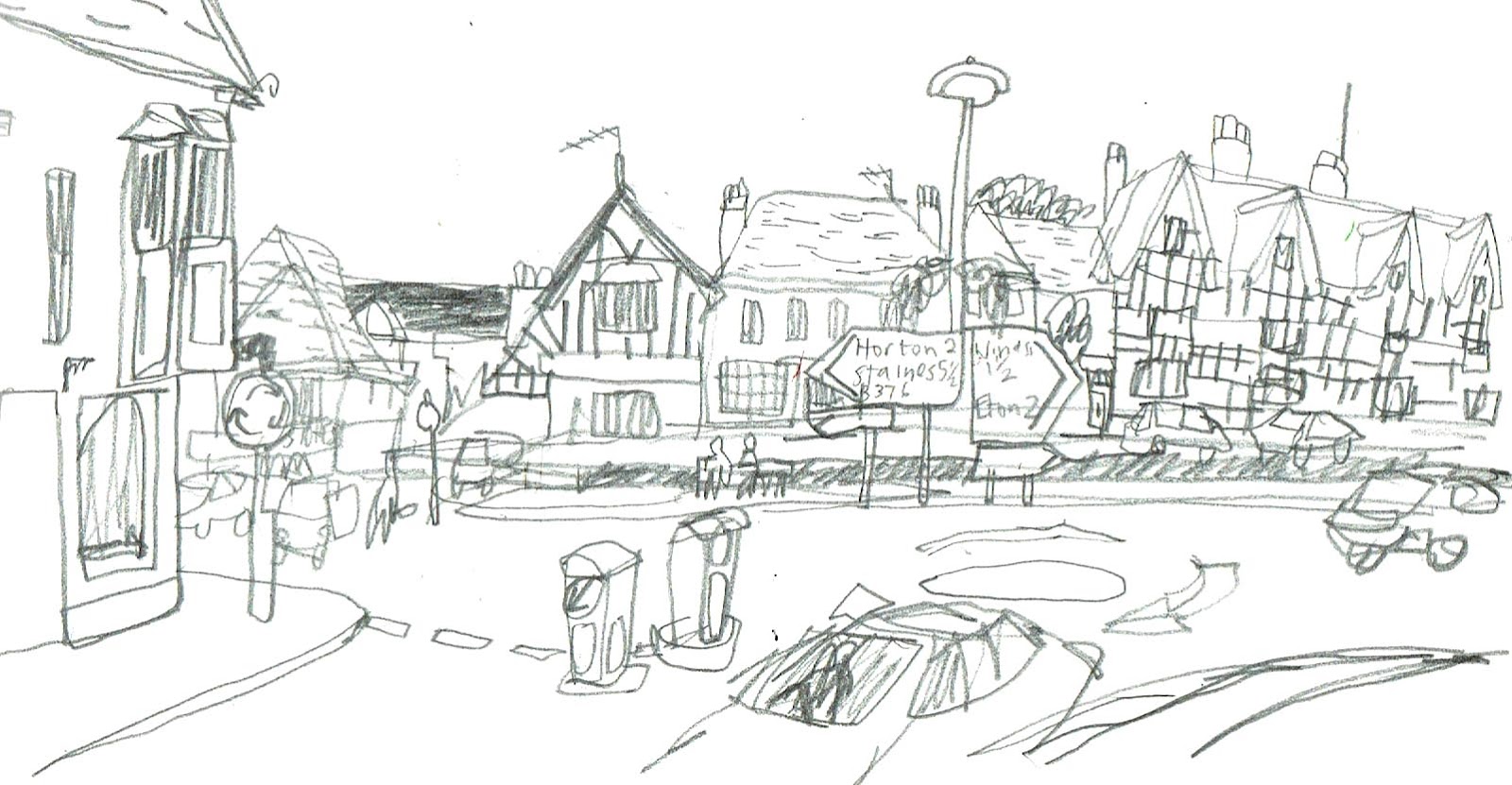
James Hobbs, Datchet roundabout, 1990

The faster we can travel the further London spreads. Through Windsor where a crowd is gathered around the lights of a film crew shooting outside the castle, and Datchet where the green embossed with mini-roundabouts is overlooked by estate agents and antique dealers. The churchyard is shady and calm, and a woman passes by on her wicker-basketed bicycle as I draw, but the planes still rumble away and we may as well still be in London.

James Hobbs, 1990


Next: Bucklebury, Combe Gibbet and the RAC


Saturday, 18 April 2020

Following Morton: the 1990 introduction

This is the original 1990 introduction to the story of my van trip around England with sketchbooks and pencils. Find out more about it here.

[Bracketed sections are comments added in 2020.]

It was at a car-boot sale near Winchester School of Art one Sunday morning in 1989 that I first came upon a battered paperback edition of HV Morton's In Search of England. First published in 1927, it tells the idiosyncratic story of a man's looping journey around England in his bull-nosed Morris. Once I had it in my hands, the temptation to flick through its pages to find his reactions to places I knew was irresistible.

It is a book that has hardly been out of print since. Morton blended an informal, humorous style with an interest with history that brought the country's past within reach of anyone who wanted it. The growing popularity of the motor car was making the towns and countryside more accessible to the public than ever before. Within 14 years it was into its 27th edition.

Morton had an aim, one that his readers evidently shared with him, and that was to "find" England. He knew what he wanted and he set out to discover it. His journey was loaded with many of the views you may expect from a gentleman's tour in the time of the Empire, so much so that by the last page he is able to turn to a country parson and pompously tell him, "You have England."

[Pomposity was the least of Morton's many failings: you can find a bookful more in Michael Bartholomew's 2004 biography of him, titled In Search of HV Morton.]

But flicking through this paperback more than 60 years later, I wasn't so sure what the bombs and bulldozers had left to be found today. I had an idea that the "heritage industry" would have packaged much of what he had described into neat bundles of visitor centres, gift shops and theme parks set against a rising tide of satellite dishes and out of town shopping centres. But before I knew it, I had bought a small camper van, loaded it with pencils and sketchbooks and had a summer of drawing stretching out before me.

As it turned out, almost everywhere had its surprises. It came as a shock to find some places exactly as he had described them, just as it was to find others so changed. But it was those unlikely events that popped up out of nowhere down country lanes looking for somewhere to park overnight that I enjoyed most, the people ready to invite you into their homes or help push the van. They were the things you could never plan. The English people don'’t seem nearly as wary of strangers as we are led to believe.

But it made me aware, too, of just how much colour and history there is a short drive up the least likely roads. We rush to the international airports with only the haziest idea of what is just over the hedge. What is closest to home is so often what is most overlooked.

James Hobbs, Bridge Street Rows, Chester, 1990.

We are regularly spoon-fed the heritage trail hype, shepherded about as if we are incapable of original thought, depriving us of any sense of discovery. Perhaps that is the natural conclusion of what Morton was encouraging in his book. But if you have the time to slow down and stay off the motorways and dual-carriageways and see what you can find, there are many more rewards. England is a compact island and it never fails to respond to the slow, patient search.

With that in mind it was at times frustrating restricting myself to follow Morton's route. We were hardly ideal travelling companions. There were times when I would have happily thrown his book out of the van window and struck out on my own way. There were roads off his tracks that I found impossible not to take, and few were disappointing when I did.

Ultimately, however, I remained faithful to Morton and his book and I suppose I'm glad of that. Had I not remained faithful I would probably still be out there somewhere even now, driving the lanes looking for somewhere to camp or, more likely, waiting yet again for the RAC man to arrive.

James Hobbs, 1990

Next: Buying, waiting, setting out: Heathrow