Showing posts with label in search of england. Show all posts

Thursday, 18 June 2020

From Romsey Abbey to Southampton docks


This is the latest in a series of posts about my journey around England in a camper van in 1990. Read an introduction to this drawing journey around England here.

[Bracketed sections like this have been added in 2020.] 

Knocking at an old farmhouse near Romsey, I’m told by a correct, middle-aged woman that I can park overnight in the track to their house but that her husband will be back soon and will want to meet me. The temptation is to say that I only want to camp overnight rather than marry their daughter, but by the time I’ve put the roof up he has swung around the corner in his Range Rover and stopped by the back of the van.

Touring vans have not had the best of publicity around the south of England recently and, apart from the running battles with travellers around Stonehenge at summer solstice time, there are farmers who have resorted to court injunctions to move on unwelcome convoys, and outbursts to local papers on the subject of the damage they were left with. A solitary van is often seen as the thin end of the wedge by landowners – let one in and more will follow – which is probably why the husband is now bearing down on me as if I had pitched camp in the middle of his croquet lawn.

I get out to meet him halfway, surprise him by shaking his hand and try to persuade him I am not someone he ought to be moving on. I summon all my efforts into coming across as respectable as I can be, and he calms before too many blood vessels are burst. I know I have made a reasonable impression when he comes out to see me again later while I’m washing up to invite me in to the house for coffee and a glass of port. “We don’t like to think of you up here on your own,” he says.

Soon I am sitting in a huge wheel-backed chair with a cat on my lap, glass of port in hand, listening to their worries about their daughter’s boyfriend, who has just arrived to take her off to a party to the sounds of much wheel spinning in the drive.

This is still commuter heartland. He is a solicitor dividing his time between London, Bristol and New York. She fusses around him, a woman apparently given to Good Works. The kitchen’s working surfaces are as clean as an operating table. There are three cars lined up in the drive.

We chat about Romsey (top image) and Lord Mountbatten of Burma, who lived in Broadlands on the edge of the town until he was blown up by IRA terrorists on his yacht in 1979. You can’t be in Romsey for too long before his name crops up. He was obviously very popular here and could be found occasionally drinking in the town’s pubs and getting up to the sort of thing that goes down well with the locals.

“The whole town went into mourning when he died,” the husband said, leaning against the Aga, “and there were these great public shows of grief. So much so that the shopkeepers all had black window displays as a sign of respect.” They laugh at the thought of something that occurs to them both at the same time. “Even the lingerie shop got involved – they filled their windows with black underwear.”


Leaving early in the morning – the night only disturbed by the daughter arriving home in the early hours as I am unburdening myself of too many cups of filter coffee, momentarily flashing my shadow across the farmhouse wall – I head up into the town.

James Hobbs, Market Square, Palmerston statue, Romsey, 1990


In the market place it is a surprise to find that rather than Mountbatten it is a statue of Lord Palmerston, twice prime minister, whose family had previously owned Broadlands, that gazes out over the square. On the corner of one building hangs a bracket that was used to hang Cromwellians in 1642. The building now houses the local Conservative club, in which there is a lot of activity.

[The statue of Palmerston – who favoured the abolition of slavery – seems safe from toppling during this time of scrutiny of the UK's historic and current racism.]


Romsey Abbey is a thing of beauty and certainly a bargain at £100, the price paid by the town when it was sold at the Dissolution, even at index-linked prices. Inside there is time to see the Anglo-Saxon rood screen and the rather gruesome tress of hair found in a Saxon coffin, but, talking to a helper in the Abbey it isn’t long before she too gets around to Mountbatten. He is still a great unifying force in the town. There is a large stone to his memory inside.

James Hobbs, Romsey Abbey, 1990


She directs me down to a bridge on the way out of town where you can get a good view of Broadlands, the large porticoed house where he lived. It will be open to the public later in the day, but for now I have to make do with the view photographers with long lenses had when Charles and Diana spent their honeymoon here in 1981.


When I reached the bridge there was every reason to suppose she’d been pulling my leg, because no large mansion was visible. An elderly man walking his dog stopped to help me.

“Come down this way and you’ll see it – I’ve spent hours here myself painting it,” and he leads me further down. His surprise is apparent when he too can see nothing of it through the bluish morning haze into the sun. It is as if it has disappeared.

“You know,” he says, “it used to be there.”


*****

James Hobbs, Southampton docks, 1990

Southampton is almost like Istanbul from the docks, if less busy. People are on their way down to the ferry to cross the water to Hythe from which chimneys puncture the sky like minarets. “Come Dancing” a battered sign announces from the next pier, a warm welcome from a tangled mess of girders and barbed wire. There is peeling paint and high fences, no unauthorised entry. It would be an eyesore in many places but here it can almost be overlooked. Cranes are everywhere and there is the great container port further up. There is little traffic today apart from a tug and a vast tanker.

The ferry is about to leave, and confusing its destination of Hythe with Ryde on the Isle of Wight, I quickly get a ticket and jump on board. Instead of the Isle of Wight I get a quick trip across Southampton Water and back. It is less momentous than other voyages that have started out from here. For 500 years it was one of the country’s leading ports, with massive city defences facing out to sea. Ships left from here for the Napoleonic wars, the Mayflower in 1620 before stopping off at Plymouth, and going into passenger transport in a yet bigger way at the beginning of this century, the White Star and Cunard Lines ran from here.

So a short trip on a ferry is a token gesture even if I did get back almost before I’d left. On board there are bicycles stacked, and work suits and ties have been discarded for shorts and trainers for the ride home to the far bank. Its passengers sit with the resignation that comes from commuting, but there is the sun, a cool breeze and even the occasional shower of spray, a class above your average ride home on the underground. Most sit inside to shelter from it, locked into books or personal stereos. I am reminded of a ferry ride up the Bosporus when shortly after leaving Istanbul a young man moved among the packed benches taking off his artificial limbs one by one waving them above his head in an attempt to collect money. I wonder here if they would even raise their eyes from their books. 


Everyone gets out at Hythe’s long pier except me, and nobody boards except the ticket collector’s granddaughter, who he chases around the deck. We, meanwhile, chase the real Isle of Wight ferry as it returns to Southampton. Ocean Village is a part of the waterfront with a typically 1980s look, a new development packaged as a place to be seen flaunting boom-time spoils. It’s like a scene from the Boat Show, except here it goes on all year. There are shops and bars to go along the jetties, a scene of conspicuous consumption that was built as a playground for those riding high on a succession of tax cuts.


But the tax cuts could never go on forever and it is as if the party is moving on to somewhere else now. Things are evidently not so easy. Among the trendy cocktail bars near Canute’s Pavilion are the empty shells of shops and ‘To Let’ notices that have been left by the receding economic tide.
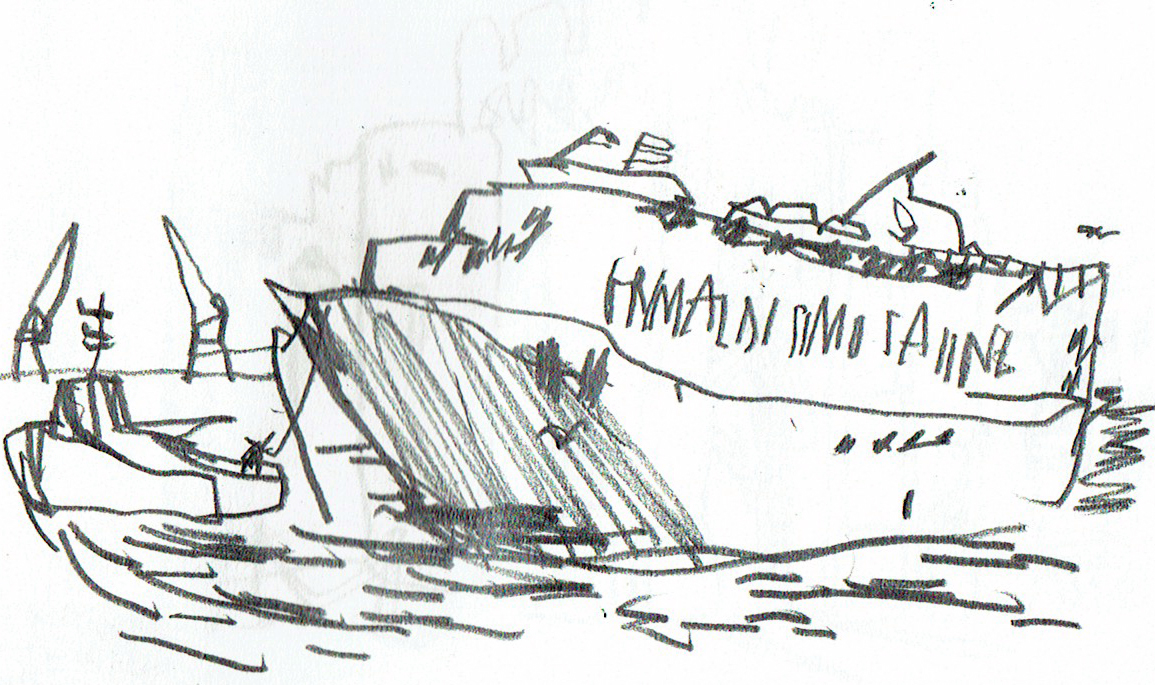
James Hobbs, Southampton docks, 1990

Less conspicuous and more enduring is the sight of a couple come to sit in the sun by the old "Come Dancing" pier - eyes closed, faces looking up, ample white flesh on show where clothing has been peeled back to feel the warmth. Another tanker passes down Southampton Water. Children eat ice creams rocking forwards and back on their bicycles while a dog sniffs around them.


At the bank to get some money before I leave, the cash machine gobbles up my card and slides its cover abruptly over the keys. The bank is shut and I have this horrible feeling it could be weeks yet before a new bank card finally catches up with me.

James Hobbs, 1990

Read on: Football violence in Bournemouth


Wednesday, 27 May 2020

Return to Winchester


Read an introduction to my drawing journey around England, which started 30 years ago.

[Bracketed sections like this have been added in 2020.] 

So I reach Winchester, which the guide books will tell you is a beautiful city stocked up with no end of history, how it used to be the capital city and one of the most important cities in Europe. But I haven't looked forward to it. I lived in Winchester for three years when I was at art school so I am well used to a dreary respectability that lurks beneath the surface. It is a city that spends the evening watching Terry and June repeats or is tucked up in bed by nine in the evening with the Daily Telegraph crossword.

[In retrospect, I seem a bit tough on Winchester here. It’s probably moved on a bit since then.]

But I arrive on different terms today, to stay a couple of nights and see it from what I hope to be a better perspective. There is no denying it is a beautiful place once you escape the one-way system that loops around the centre with its share shops and wine bars. I leave the van by the park and walk in.

It is a gentle and restrained city but rather like someone who has outgrown their clothes; it is more like a town with the historical trappings of a city. The cathedral sits like a ship run aground, left high and dry as the city's importance as one time capital of England has ebbed about it.

Winchester is probably still recovering. Although there are Iron Age settlements nearby, it was developed by the Romans who laid out a grid system of streets and built its defensive wall. By the seventh century the Saxons had founded its first cathedral and St Swithun became its most famous bishop. King Alfred came here to live and made it his capital. And from then until the 12th century Winchester swung. Edward the Confessor was crowned here, William the Conqueror rebuilt the royal palace and the Domesday Book was written here. Thanks to records written at the time more is known about Winchester than any other city in the Middle Ages. It was stuffed full of traders from all over Europe, densely populated for its time, the second largest town in England.

You can get a sense that it hasn't all been downhill since from a walk down its High Street (top image). The shops are smart and expensive. Where there are gaps, shoppers can see through windows in the hoardings to where teams of archaeologists are sifting through remains before builders and concrete take over.

Winchester survived its loss of power and wealth to London, the Black Death (that left it with fields and orchards within the city walls), and the Civil War. Later the coming of the railway helped revitalise it: what had once been the nation's centre had become little more than a market town until the trains arrived. And it saves it still, in a sense. An hour from Waterloo on the train, it is the perfect retreat for people working in the City and wanting to escape to a home in peace and tranquility. Winchester is not a playground; the only cinema has been demolished to make way for more housing for the elderly.

A bearded man with a rucksack accosts me for money so he can get a bus to his family in Southampton. It becomes a familiar story. He greets me cheerfully later when I bump into him in a cafe. He seems wonderfully out of place here and tells me which bench by the cathedral an old lady goes to sit to offer her services as a self-appointed sexologist. At times it seems like nobody more than stockbrokers and retired wing-commanders live here so it is a relief to see this hint of a more quirky side of life.

James Hobbs, Cheyney Court, Winchester, 1990

The cathedral's spireless tower gives it an incomplete look and yet it still manages to dominate the skyline. Its first tower fell down in 1107. Having one of the longest naves in the country, it effectively cuts the city in two, keeping Winchester College and the water meadows apart from the rest of the town. In the summer the Cathedral Close livens up as people strip off to eat their sandwiches around the gravestones. Today they are taking cover by the west door, waiting for a shower to end on their way back from communion.

A walk down the south transept can be a disorientating experience as arches lean and the tiled floor undulates. Suddenly it is an uphill walk. The trouble is caused by the flood plain on which it was built, the River Itchen having rotted the wooden foundations to such an extent that in places nothing is either horizontal or vertical. By the lady chapel is a statue of William Walker, the man who worked underwater to secure the foundations at the beginning of the [20th] century, showing him in full diving gear, his hands outstretched, palms up.

What have also survived in a less than perfect state are the bones of an array of Saxon kings perched in boxes along the top of the side screens. Each contains a haphazard cocktail of regal remains now, their contents having been scattered around by Cromwell's troops on one of his visits. We can only assume that one king's bones look pretty much like another's and they were swept back into these boxes as they were found. Further along the aisle is a memorial to Jane Austen who came to live in Winchester to be close to her doctor. Sadly it wasn't close enough and she died soon after in a house nearby.

The streets in the afternoon become busier with the boys from the college going with their parents for tea, couples ambling down the pedestrianised High Street window shopping, walking off the Sunday lunch. Even the few punks Winchester has to offer seem as respectable as the city expects. Some sit with their dog around the Butter Cross, which stands awkwardly close to a bakery with a traffic cone perched high on one of its spires.

James Hobbs, Butter Cross, Winchester, 1990

A walk down by the water meadows is a popular thing to do on a Sunday afternoon. Homesick little boys in suits are taking awkward strolls with parents past the cricket pitches, and happier-looking, scruffier boys peer into the river from bridges looking for trout. The meadows are remarkably unspoiled despite being so near to the city centre. A dual-carriageway snakes around the foot of St Catherine's Hill, the footpath to its summit passing beneath it. It's a steep climb that leaves me puffing. At its top there is a maze, the old Iron Age fort, and a wonderful view over the city.

For a city that has experienced such turmoil and fervour down its historic past, Winchester has earned a breather now. Those who still like to think of England as being a gentle, sleepy place brimming with royalty and history could only find it delightful. I'm just glad I don't have to live here anymore. To me it is a place that time has left behind, not somewhere I would want to live, but perfect for a day out as a retreat from a truer more real world. 

The next day, having camped in a pull-in high up in the fields out of the city, fields famed for their corn circles that will no doubt appear later in the summer, and among the stacked and numbered trunks of trees sliced down by the hurricane in 1987, I set out for the church of St Cross. Down a lane towards the water meadows and through an arched gateway there is a large quadrangle bordered by the houses of the men who live at the Hospital of St Cross. It was founded in 1136 to house 13 poor men and provide free dinners for 100 others, and a few of its present inhabitants are sitting on benches in the sun looking towards the church. Besides the three rooms that make up their quarters, there are the old kitchen, a dining room and a hall adjoining the gatehouse.

James Hobbs, St Cross, Winchester, 1990

The church is beautifully proportioned and simple, and built at a time when Norman was (my guide book tells me) becoming Early English. Its quiet expanses of stone, wood and glass accentuate corners of activity. “Bird Beak Window” a sign says. Above it is the carved zig-zag arch and 500-year-old glass.

Along the back pew the May edition of the parish magazine has been sorted into piles fastened with elastic bands; Mrs Giles - 5, Miss Stanwyck - 9, and the visitors book left open. There is the mystifying nationality column, and then a comments section.
Parents married here in 1912.
Peaceful.
Norman? (This sounds like an attempt to communicate with the dead.)
Damp!
Kick out the darkness and let the light bleed in.

There is, as Morton would have said, a book to be written about the comments made in church visitors books.

The Wayfarers' Dole, the bread and ale handed out to travellers who demand it from the gatehouse, does not show the same unchanging qualities as the Hospital. Seven hundred years of generosity has resulted in a corner of a white Mothers' Pride loaf and a token sample from a plastic bottle of Webster's Yorkshire Bitter, both served with badly worn charity. A man serves it with the resigned air of one who has been through this a thousand times.

In Morton's time there was always a steady stream of wanderers stopping here for refreshment, the vagrancy laws keeping the homeless on the move between towns. Now the homeless are more static in city doorways or wandering the streets asking for change, and rarely seen on the grass verges of main roads. Tourists who have read Morton's book are the ones most likely to ask for it now, the porter tells me.

Taking the wooden platter and small earthenware goblet to a bench in the sun I can only hope they have not come too far for this. The hungry are better off heading straight to the pub on the corner by the main road where a more satisfying lunch can be found.

James Hobbs, 1990

Read on: Romsey, Hampshire, and Southampton docks

See more of my drawings on Instagram.

Saturday, 18 April 2020

Following Morton: the 1990 introduction

This is the original 1990 introduction to the story of my van trip around England with sketchbooks and pencils. Find out more about it here.

[Bracketed sections are comments added in 2020.]

It was at a car-boot sale near Winchester School of Art one Sunday morning in 1989 that I first came upon a battered paperback edition of HV Morton's In Search of England. First published in 1927, it tells the idiosyncratic story of a man's looping journey around England in his bull-nosed Morris. Once I had it in my hands, the temptation to flick through its pages to find his reactions to places I knew was irresistible.

It is a book that has hardly been out of print since. Morton blended an informal, humorous style with an interest with history that brought the country's past within reach of anyone who wanted it. The growing popularity of the motor car was making the towns and countryside more accessible to the public than ever before. Within 14 years it was into its 27th edition.

Morton had an aim, one that his readers evidently shared with him, and that was to "find" England. He knew what he wanted and he set out to discover it. His journey was loaded with many of the views you may expect from a gentleman's tour in the time of the Empire, so much so that by the last page he is able to turn to a country parson and pompously tell him, "You have England."

[Pomposity was the least of Morton's many failings: you can find a bookful more in Michael Bartholomew's 2004 biography of him, titled In Search of HV Morton.]

But flicking through this paperback more than 60 years later, I wasn't so sure what the bombs and bulldozers had left to be found today. I had an idea that the "heritage industry" would have packaged much of what he had described into neat bundles of visitor centres, gift shops and theme parks set against a rising tide of satellite dishes and out of town shopping centres. But before I knew it, I had bought a small camper van, loaded it with pencils and sketchbooks and had a summer of drawing stretching out before me.

As it turned out, almost everywhere had its surprises. It came as a shock to find some places exactly as he had described them, just as it was to find others so changed. But it was those unlikely events that popped up out of nowhere down country lanes looking for somewhere to park overnight that I enjoyed most, the people ready to invite you into their homes or help push the van. They were the things you could never plan. The English people don'’t seem nearly as wary of strangers as we are led to believe.

But it made me aware, too, of just how much colour and history there is a short drive up the least likely roads. We rush to the international airports with only the haziest idea of what is just over the hedge. What is closest to home is so often what is most overlooked.

James Hobbs, Bridge Street Rows, Chester, 1990.

We are regularly spoon-fed the heritage trail hype, shepherded about as if we are incapable of original thought, depriving us of any sense of discovery. Perhaps that is the natural conclusion of what Morton was encouraging in his book. But if you have the time to slow down and stay off the motorways and dual-carriageways and see what you can find, there are many more rewards. England is a compact island and it never fails to respond to the slow, patient search.

With that in mind it was at times frustrating restricting myself to follow Morton's route. We were hardly ideal travelling companions. There were times when I would have happily thrown his book out of the van window and struck out on my own way. There were roads off his tracks that I found impossible not to take, and few were disappointing when I did.

Ultimately, however, I remained faithful to Morton and his book and I suppose I'm glad of that. Had I not remained faithful I would probably still be out there somewhere even now, driving the lanes looking for somewhere to camp or, more likely, waiting yet again for the RAC man to arrive.

James Hobbs, 1990

Next: Buying, waiting, setting out: Heathrow