Friday, 17 July 2020

Weymouth, Portland and a cow


This is the latest in a series of posts about my journey around England in a camper van in 1990. Read an introduction to this drawing journey around England here.

[Bracketed sections like this have been added in 2020.] 

Having parked overnight on the site of an old silage clamp, I realise, browsing over the map eating my Weetabix, that I'm only a mile or two up the road from Stinsford, which is where Thomas Hardy is buried. Morton didn't go here but I see no reason why that should put me off.

As I listen to the 6am news on the radio, I pass all the signs marking the route to Hardy’s Cottage, his birthplace [owned by the National Trust], which won't be open for hours, and make straight for the churchyard. He is – mostly – buried in Westminster Abbey: only his heart remains here. The grave is hard to miss, coffin shaped and beneath a yew tree, but there is more than one Thomas Hardy here, along with a Poet Laureate, Cecil Day Lewis. Even death has its attractions. This is a churchyard to be seen dead in.

I stop off at Dorchester to collect some mail, stock up with a few tins of food and UHT milk, which doesn't go off too quickly in the fridge-free van. I pass down through “Hardye Arcade”, a dreary little line of shops, on my way to the post office. Poor old Hardy. What makes me even more aware of what part of the country I'm heading for is the way that I am called “m’dear” by the woman who sells me a newspaper.

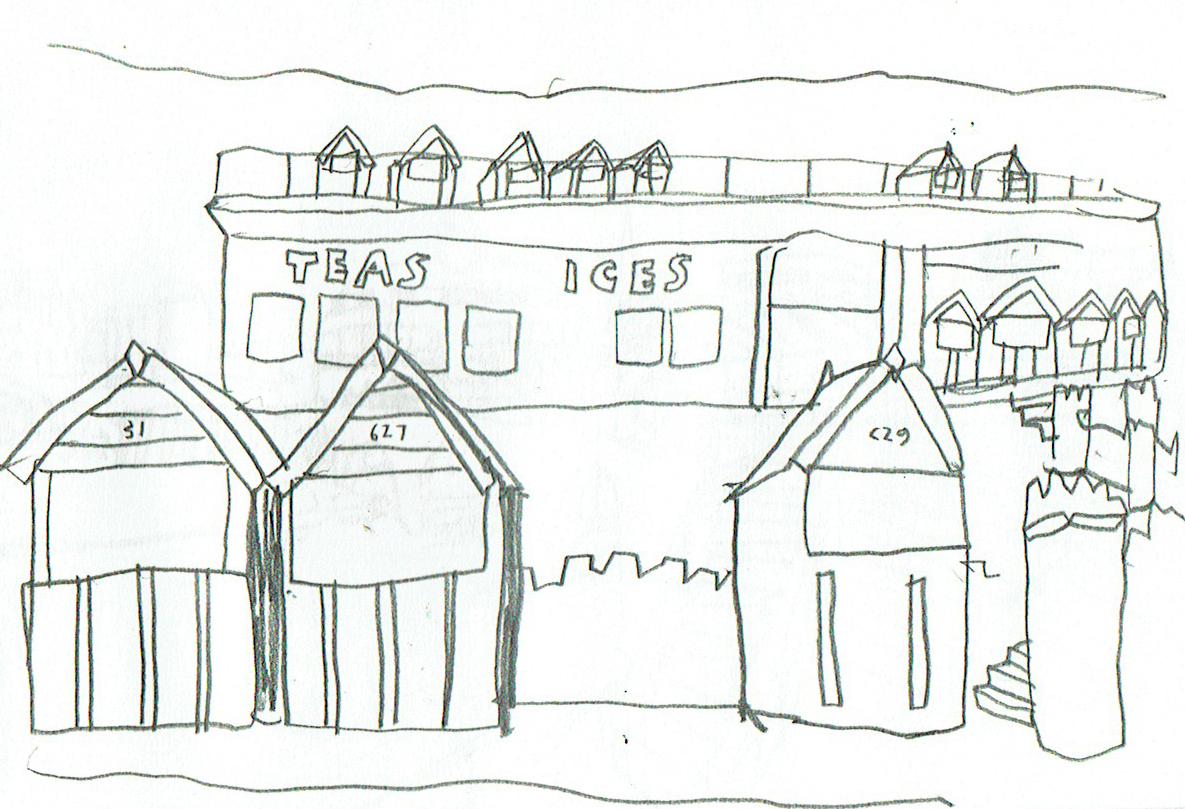
There is a regal air to Weymouth's seafront, a gently bending terrace of Georgian buildings along the esplanade rubbing shoulders with gift shops and restaurants. The scene is overlooked by a slightly frivolous statue of George III, like a brightly painted outsize Airfix model in his full regalia. This the king who bravely tried out the modern bathing machine of 1789. His ghost still haunts the town in a sense, his name popping up wherever you go, like continually following footsteps in the sand. It’s surprising he doesn't appear more in the gift shops in one form or other, as in him, for once, there is something that sets Weymouth apart from other seaside towns. Instead they sell the typical racks of pink fluffy animals, personalised teacups, and plastic novelties in willie or knocker shapes. [Alan Bennett’s play, The Madness of George III, which led to the film of a similar name, was published in 1991, the year after my van trip.]

The sea front is taken over by a cavalcade of motorcycles that cruise down and back, serious bikers in serious leather jackets on their way to nowhere in particular. Anita Lee, “daughter of the famous Gypsy Lee”, is in her caravan by the beach waiting for custom, but she would have done well to have listened to the weather forecast; it has started raining and she could have stayed at home. She is visible through the door of her van killing time by leafing through the pages of the Sun. 

Down one of the little streets behind, Mr Sanny is on his synthesiser, entertaining a pub full of lunchtime drinkers with Abide With Me as a heated argument breaks out between two drinkers. The loudest shout of all is a “You keep out of this!” although whether it is aimed at Mr Sanny, who stoically continues, it is hard to say.

Weymouth feels as if it is on an edge, utterly English, but ferries leave its terminal for Cherbourg and the Channel Islands and there is a little Frenchness about its river harbour. There is a gentle pomposity to the town, which I just can't help liking.

***

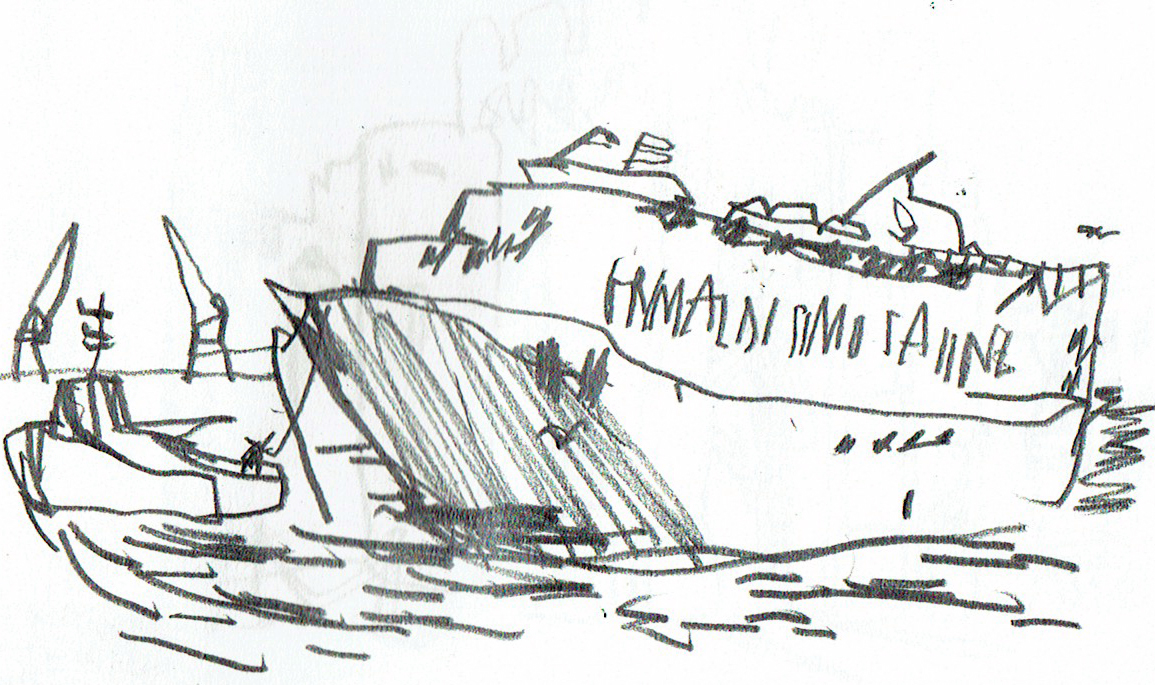
Portland is not the beautiful place I had somehow expected it to be. Dangling from the umbilical cord of Chesil Beach, it is almost, but not quite, an island. It his an industrial landscape, ugly to approach and not at all remote as I had imagined. There is the naval base and quarries that have supplied materials for buildings around the world, but quite what Portland has received in return is hard to spot. The houses are low and terraced in a treeless terrain. Footpaths riddle the stone-walled fields, purposefully signposted at the outset but ending on more than one occasion in sheer cliffs left by quarrying. It is as if fields have dropped down out of sight one by one.

James Hobbs, Portland, 1990

The quarry cranes are motionless today, in suspended animation, interspersed with rubble and numbered blocks of stone. The exposed country roads are dusty, wrapping around rubbish in the gutters like larva to fossilise it. It is so dry it makes me thirsty just to be here.

At Portland Bill I open a tin of beans and listen to the FA Cup Final on the radio. There is the spectacle of the meeting of the tides to watch, the collision of waters known as the Race that results in fierce currents that the fishing boats of Weymouth have to battle their way through. This is how Weymouth and Portland seem - two pieces of a jig-saw that do not fit but are hammered together until they do so. It is an odd marriage of industry and holidays, cosy south coast warmth and exposed barren nudity.

Hounded back through Weymouth by supermarket trolley pushing youths in fancy dress demanding money for the ITV Telethon charity appeal, I find myself looking to camp at the bottom of a hill with the chalk figure of George III riding a horse cut into it. There is a farmhouse, which, considering it is at the bottom of a lane lined with thatched cottages, is a disappointing bungalow on a corner. The woman who answers the door directs me to a field down a track where I can park for the night. She gives the van a funny sort of look over my shoulder that I'm accustomed to now. A dull, homey smell comes from the doorway.

The field is ringed with a high fence, perhaps a relic of the farmer's failed plans to diversify into taking campers, now long past by the state of the crumbling toilet block that remains in the middle. I do not have the place entirely to myself; I am sharing with a cow, its calf and scattered assortments of farm machinery abandoned to the weeds. I spend the evening in the pub up the road making half a pint of bitter, which took 60 of the 83 pence in my pocket, stretch across the night.

The offending cow

Later, I lock myself into the field with the cow and calf by tying the gate shut with the binder twine left for the purpose. It is six in the morning when I am awoken with a jump as the van lurches from side to side. My friend the cow has discovered that it is the ideal height for relieving an irritating itch on her back.

James Hobbs, 1990


Thursday, 25 June 2020

Leeds go mad in Dorset


This is the latest in a series of posts about my journey around England in a camper van in 1990. Read an introduction to this drawing journey around England here. 

[Bracketed sections like this have been added in 2020.]  

It's May Day Bank Holiday weekend in Bournemouth, 25C and queues of cars are edging open-windowed or roofless towards the seafront where the beach is already packed. It is the fulfilment of all those winter yearnings for a tan. The most unlikely looking windows are being used to sell refreshments from, but the busiest and loudest is a pub near the pier from which comes chanting and a sort of singing.


I had parked under the shade of trees at Branscombe further up the coast, once, and not so very long ago, a separate town but now congealing like the rest of the south coast into one long line of development. It is easy to see on a day like this how Bournemouth could have become so popular in the last 200 years: long sandy beaches, pine trees, and green, south-facing cliffs. The traditional and familiar attractions of days out at the seaside seem to be alive and well: there are the smells of fish and chips and sun lotion, a Punch and Judy tent, waterskiers, acres of pale bodies, family arguments and amusement arcades, all these, but with sun too.


But sun and alcohol are not mixing too well at the pub by the pier (top image). Today is the last day of the football season and the visitors, Leeds United, are expecting to get promotion into the first division [the Premier League was launched in the 1992-93 season] at the expense of Bournemouth Town, and to this end they have set about trashing the place. 

Apart from the drinkers, who are watched by groups of police, there is a larger and yet more ugly gathering further on by the beach. It could be 1,500, it could be 2,000, but they are a mass of young men that seem to have come from just a handful of moulds. Short haired, T-shirted, wearing shorts or jeans, holding cans of alcohol that are crushed and discarded on the pavement as quickly as they are emptied, they are seething, singing, chanting, kicking footballs high into the air so that three or four of them keep popping up as they gather for the march up to the ground for the game.


I cannot take my eyes off this sight. It is almost like an old circus sideshow where those with hideous deformities are paraded for the public. This crowd is ugliness itself, unlike anything I have seen before, a bundle of fascism and bigotry I gather from the songs they are singing. It is frighteningly magnetic to watch. As a group they are all of a single mind, and not a very broad one.


[This weekend of violence by Leeds fans in Bournemouth grabbed the headlines in a way I didn’t really recognise at the time. I didn't even draw the fans, for instance. There were more than 100 arrests and 12 police were seriously injured over the weekend I was in Bournemouth. There were even questions in Parliament about the violence that unfolded.] 

The Bournemouth Evening Echo has not missed out. “Thugs on Rampage” runs the headline above stories from the night before. Beach huts have been set alight. In the town centre windows are boarded up, some in anticipation, others evidently repairing what has gone before. Mounted police roam the pedestrianised centre while fans wearing “Bournemouth Invasion” shirts pose for souvenir photographs next to them.


Just to get into a supermarket is not easy, the way in barred by a policeman. I first have to convince him that it is food I want to buy rather than anything alcoholic. There are more police inside roaming around the aisles. They call everyone “lad”, trying to defuse the tension with a forced good humour.


For no apparent reason, the crowd by the beach takes it upon itself that it is time to leave for the walk to the ground, and, as one, it makes off leaving the debris that until then it has been impossible to see. The shouts and singing seem to hang in the air long after they have all leaked away up the road.


What surprises me is just how prepared people are to accept that this is the way things must be, to go on regardless as if this ugly violence is entirely normal. Half naked women push their way through the fringes of the fans to join the queue for ice creams, going barefoot through the empty beer cans littered around as if it was the most normal thing in the world. Police stand around to almost heighten the crowd's sense of importance, a sign of the fans’ power to disrupt, acting as escorts to a roving lawless zone. A camouflaged military vehicle I associate with the streets of Belfast looks on. I am amazed that a kick around between two teams of eleven can be worth all this.

James Hobbs, Bournemouth sea front, 1990


The more usual beach noises return as kick off approaches. Some of those without tickets turn on radios to listen to the commentary so that they overlap across the sands, never out of earshot. The air is freed from sirens for a while but it is replaced by racist chants from groups draped in Union Jacks who troop up and down the beach looking for topless sunbathers.


We hear the game won by the Leeds team down on the beach, looking out to the still sea that few people actually bring themselves to swim in. The sight of a large offshore structure for drilling oil must be as responsible for this as anything. I plan to get well out of town for the night before the ground empties and the Leeds celebrations begin. I am well up a very deserted country lane before the late kick-off results come over the radio.


Two days later and the wind and rain are back, the deserted beaches marked by tractor tyres where the sand has been raked and cleaned. The flashing orange lights of council cleaning lorries have taken over from the blue ones of Saturday’s police cars. A few people are about. There is a children’s roundabout in the shape of a teapot around which seated toddlers turn in teacups at the end of which they head with their carers, like me, to the domed cafe on the pier. 

James Hobbs, Happyland Amusements, Bournemouth, 1990


It is more likely to be like this when you visit Bournemouth, you and a few others wondering where everybody else is. An elderly lady strolls in the gardens to the relaxing cry of seagulls, leaning on her only slightly younger companion, enjoying the flowerbeds and pointing her walking stick at shrubs. I pass just in time to hear her lean towards her friend and say: “You know Mrs Thatcher looked a picture in the paper today...” Bournemouth is back to its old self. 

James Hobbs, 1990 

[Further posts about this journey will follow here soon. This is a link to details about my journey, which started 30 years ago.] 


Thursday, 18 June 2020

From Romsey Abbey to Southampton docks


This is the latest in a series of posts about my journey around England in a camper van in 1990. Read an introduction to this drawing journey around England here.

[Bracketed sections like this have been added in 2020.] 

Knocking at an old farmhouse near Romsey, I’m told by a correct, middle-aged woman that I can park overnight in the track to their house but that her husband will be back soon and will want to meet me. The temptation is to say that I only want to camp overnight rather than marry their daughter, but by the time I’ve put the roof up he has swung around the corner in his Range Rover and stopped by the back of the van.

Touring vans have not had the best of publicity around the south of England recently and, apart from the running battles with travellers around Stonehenge at summer solstice time, there are farmers who have resorted to court injunctions to move on unwelcome convoys, and outbursts to local papers on the subject of the damage they were left with. A solitary van is often seen as the thin end of the wedge by landowners – let one in and more will follow – which is probably why the husband is now bearing down on me as if I had pitched camp in the middle of his croquet lawn.

I get out to meet him halfway, surprise him by shaking his hand and try to persuade him I am not someone he ought to be moving on. I summon all my efforts into coming across as respectable as I can be, and he calms before too many blood vessels are burst. I know I have made a reasonable impression when he comes out to see me again later while I’m washing up to invite me in to the house for coffee and a glass of port. “We don’t like to think of you up here on your own,” he says.

Soon I am sitting in a huge wheel-backed chair with a cat on my lap, glass of port in hand, listening to their worries about their daughter’s boyfriend, who has just arrived to take her off to a party to the sounds of much wheel spinning in the drive.

This is still commuter heartland. He is a solicitor dividing his time between London, Bristol and New York. She fusses around him, a woman apparently given to Good Works. The kitchen’s working surfaces are as clean as an operating table. There are three cars lined up in the drive.

We chat about Romsey (top image) and Lord Mountbatten of Burma, who lived in Broadlands on the edge of the town until he was blown up by IRA terrorists on his yacht in 1979. You can’t be in Romsey for too long before his name crops up. He was obviously very popular here and could be found occasionally drinking in the town’s pubs and getting up to the sort of thing that goes down well with the locals.

“The whole town went into mourning when he died,” the husband said, leaning against the Aga, “and there were these great public shows of grief. So much so that the shopkeepers all had black window displays as a sign of respect.” They laugh at the thought of something that occurs to them both at the same time. “Even the lingerie shop got involved – they filled their windows with black underwear.”


Leaving early in the morning – the night only disturbed by the daughter arriving home in the early hours as I am unburdening myself of too many cups of filter coffee, momentarily flashing my shadow across the farmhouse wall – I head up into the town.

James Hobbs, Market Square, Palmerston statue, Romsey, 1990


In the market place it is a surprise to find that rather than Mountbatten it is a statue of Lord Palmerston, twice prime minister, whose family had previously owned Broadlands, that gazes out over the square. On the corner of one building hangs a bracket that was used to hang Cromwellians in 1642. The building now houses the local Conservative club, in which there is a lot of activity.

[The statue of Palmerston – who favoured the abolition of slavery – seems safe from toppling during this time of scrutiny of the UK's historic and current racism.]


Romsey Abbey is a thing of beauty and certainly a bargain at £100, the price paid by the town when it was sold at the Dissolution, even at index-linked prices. Inside there is time to see the Anglo-Saxon rood screen and the rather gruesome tress of hair found in a Saxon coffin, but, talking to a helper in the Abbey it isn’t long before she too gets around to Mountbatten. He is still a great unifying force in the town. There is a large stone to his memory inside.

James Hobbs, Romsey Abbey, 1990


She directs me down to a bridge on the way out of town where you can get a good view of Broadlands, the large porticoed house where he lived. It will be open to the public later in the day, but for now I have to make do with the view photographers with long lenses had when Charles and Diana spent their honeymoon here in 1981.


When I reached the bridge there was every reason to suppose she’d been pulling my leg, because no large mansion was visible. An elderly man walking his dog stopped to help me.

“Come down this way and you’ll see it – I’ve spent hours here myself painting it,” and he leads me further down. His surprise is apparent when he too can see nothing of it through the bluish morning haze into the sun. It is as if it has disappeared.

“You know,” he says, “it used to be there.”


*****

James Hobbs, Southampton docks, 1990

Southampton is almost like Istanbul from the docks, if less busy. People are on their way down to the ferry to cross the water to Hythe from which chimneys puncture the sky like minarets. “Come Dancing” a battered sign announces from the next pier, a warm welcome from a tangled mess of girders and barbed wire. There is peeling paint and high fences, no unauthorised entry. It would be an eyesore in many places but here it can almost be overlooked. Cranes are everywhere and there is the great container port further up. There is little traffic today apart from a tug and a vast tanker.

The ferry is about to leave, and confusing its destination of Hythe with Ryde on the Isle of Wight, I quickly get a ticket and jump on board. Instead of the Isle of Wight I get a quick trip across Southampton Water and back. It is less momentous than other voyages that have started out from here. For 500 years it was one of the country’s leading ports, with massive city defences facing out to sea. Ships left from here for the Napoleonic wars, the Mayflower in 1620 before stopping off at Plymouth, and going into passenger transport in a yet bigger way at the beginning of this century, the White Star and Cunard Lines ran from here.

So a short trip on a ferry is a token gesture even if I did get back almost before I’d left. On board there are bicycles stacked, and work suits and ties have been discarded for shorts and trainers for the ride home to the far bank. Its passengers sit with the resignation that comes from commuting, but there is the sun, a cool breeze and even the occasional shower of spray, a class above your average ride home on the underground. Most sit inside to shelter from it, locked into books or personal stereos. I am reminded of a ferry ride up the Bosporus when shortly after leaving Istanbul a young man moved among the packed benches taking off his artificial limbs one by one waving them above his head in an attempt to collect money. I wonder here if they would even raise their eyes from their books. 


Everyone gets out at Hythe’s long pier except me, and nobody boards except the ticket collector’s granddaughter, who he chases around the deck. We, meanwhile, chase the real Isle of Wight ferry as it returns to Southampton. Ocean Village is a part of the waterfront with a typically 1980s look, a new development packaged as a place to be seen flaunting boom-time spoils. It’s like a scene from the Boat Show, except here it goes on all year. There are shops and bars to go along the jetties, a scene of conspicuous consumption that was built as a playground for those riding high on a succession of tax cuts.


But the tax cuts could never go on forever and it is as if the party is moving on to somewhere else now. Things are evidently not so easy. Among the trendy cocktail bars near Canute’s Pavilion are the empty shells of shops and ‘To Let’ notices that have been left by the receding economic tide.

James Hobbs, Southampton docks, 1990

Less conspicuous and more enduring is the sight of a couple come to sit in the sun by the old "Come Dancing" pier - eyes closed, faces looking up, ample white flesh on show where clothing has been peeled back to feel the warmth. Another tanker passes down Southampton Water. Children eat ice creams rocking forwards and back on their bicycles while a dog sniffs around them.


At the bank to get some money before I leave, the cash machine gobbles up my card and slides its cover abruptly over the keys. The bank is shut and I have this horrible feeling it could be weeks yet before a new bank card finally catches up with me.

James Hobbs, 1990

Read on: Football violence in Bournemouth


Monday, 1 June 2020

Covid-19 and me

[This post was written in June 2020, when Covid was in its first mad rush. Some of what it contains is outdated now as the medical response has caught up and systems have been put in place, although as I write this (January 2021) things are perhaps worse than ever here in London. Long Covid is now recognised, and I am now well recovered, in the main. I'm tempted to delete this post as being outdated, but it captures where I was when I put it together, and reflects the nasty nightmarish hell that will hopefully be put behind us before too long.]

I’m currently in the process of recovering from Covid-19, and beyond grateful to be able to write the first part of this sentence. I know others who have been through it too, and for each of us it seemed a bit different. While the grim coronavirus experience is still all-too-fresh in my mind, here are some of the things that helped me get through. If you’re unlucky enough to get Covid-19, you may find some parts of my experience useful, or you may not. I’m well aware that nothing is certain with Covid-19 and that what I write here will be contradicted by someone else’s experience. That is how this virus seems to work.

Firstly, I should say I’m a previously fit and healthy 60-year-old white man living in north London with his wife and two young-adult daughters. I cycle, I run, I’m a stranger to hospitals (apart from during my lightning appendix adventure in Switzerland a couple of years ago, but that’s another story). I work at a university in central London, and I draw and write.

None of this is advice. This is just what helped me. What worked for me may well not be right for you. And advice will, no doubt, develop as more is understood about Covid-19.

The view from my isolation bed, drawn on day 62

Day 1: I’m not even entirely sure when it started, although 26 March 2020 is marked in my diary. I was working from home from mid March and not long after I didn’t feel quite right. I was tired and achey, but it coincided with the inevitable stress of getting geared up for working from home, and the emotional element of the world changing before our eyes in the most unreal, dreamlike way. We are lucky to have a foldout bed in the workspace at the top of the house where I could isolate myself.

My symptoms at the start? Aches, tiredness, a tightness of the chest, an occasional fluttering (odd to call it that, but that’s how it felt) in the top of my chest, occasional sharp spasms of pain in my limbs and abdomen that disappeared as soon as they arrived, and occasional raised heart rate. I never had either the dry cough or the fever (I woke one night in a sweat, but I still think that was a different duvet issue rather than a fever). This confused us. Official UK information said at that time that without those two symptoms it was unlikely you had Covid-19. Later, the loss of smell and taste was added to the list: I never had that as a symptom either. Did I just have regular flu? At some point, by which point I had already isolated myself, it became obvious it was Covid-19 that I had. The increasing breathing difficulties and fatigue seemed the most obvious signs.

Days 2-8: In bed, keeping as still as possible, tackling increasing waves of breathlessness, sleeping, and keeping anxiety at bay. The breathlessness could come while I was sitting or lying quietly. The worst part was not knowing if this was part of process of deterioration. Anxiety and breathing difficulties is not an enjoyable combination. Distraction techniques – TV, radio, podcasts (see below) – helped me through. Trips down the stairs to the first-floor bathroom were very slow, and fraught with worries about contamination. Door handles, light switches, flush handles, towels, toothpaste: we cleaned and segregated as we could. The way in which I am most lucky in this whole story is with the people I share my life with, who brought love and attention, food and drink to me, daily, hourly, and who thought straight when I couldn’t.

Day 9: I thought I was improving a little. I got up on day 9, made porridge, put out the recycling, all very gently. Whether this resulted in or merely coincided with my first relapse I’m not sure, but I was soon back in bed and feeling worse than during the first eight days.

Days 10-67*: This was the start of my worst time, physically and mentally. Cases and deaths in the UK were rising exponentially at this point, and the prime minister was taken into intensive care. There were the sounds of sirens outside, and the girls were leaving food at my door. My symptoms were still spells of shortness of breath, tight chestedness, fatigue. We rang the NHS 111 line during this time, and also our GP, who rang me daily for a while during my worst spell. A process of improvement and relapse in a slowly improving way has continued since about day 22. Days pass without breathlessness, and then return. From time to time I have to think to breathe, by which I mean it needs to become a conscious act. The fatigue is a constant over this time. (* I'm on day 67 as I write.)

Here are some things that helped me through this time of Covid-19 and recovery.

Drinking water, lots: I heard people were recommended three litres a day, but I could only manage two litres. Sipping slowly eased, momentarily, the feeling of tightness in the throat. The mouth dries out quickly if you’re breathing through your mouth as you lie and rest.

Breathing exercises, clearing lungs, mental health: I found some information through links sent to me via different NHS sources. The Lancashire Teaching Hospitals NHS Foundation Trust have great info on dealing with Covid-19 recovery. And this one on breathing exercises from doctors at Queen's Hospital, London, was sent via a family member early on in lockdown.


Distractions: TV and radio of the most gentle and escapist kind helped from time to time. This meant TV series (The Detectorists, This Country, Mortimer and Whitehouse: Gone Fishing), reruns of old cricket Tests on Radio 5 Live, football repeats of old international matches, and Mindful Mixes on BBC Sounds. For a while I escaped via the Antiques Road Show and the quiz show Pointless: this has now, mercifully, passed, but they helped me through. Nothing is off limits if it helps you get through.

Friends and relations: It was lonely being at the top of the house, even though I had my family at hand. Respect to those who are going through this alone! Honestly, nobody knows what they are going through. Strength to you if you are reading this now! I was messaging friends and family, replying to their requests for updates, and we had a London family WhatsApp group to share information about each other. I have a good friend going through a very similar experience to mine at exactly the same time, which is useful, if unfortunate. We share things as we come across them.

Support group: I came across the Body Politic Covid-19 support group on day 36 via a reference in a Guardian article. It is a Slack group - you request to join and are sent a link to access it, and to introduce yourself, using the relevant channels. It was a such relief to find this group of people having similar experiences to me. Through this you can find links to useful research, articles, surveys and current thinking. I mostly interacted in the UK channel, where I found people related to things in a way similar to mine. Many of the group’s members are in the US, particularly in New York, where the medical jargon and systems are different to those in the UK. There are elements of the group, of course, that you may want to avoid. It’s a great place to ask questions and get useful advice, but there’s also the danger of finding new things to worry about. There are channels for #victories and #positivity, which can lift the soul and offer optimism. This forum was the place that helped me not feel alone. Hail its founders.

There are Facebook groups too, such as this one, if Facebook is your thing. You can find support and links to further reading on the Long Covid website.

Diet: I skipped inflammatory foods. It’s easy to search for what this means.

Vitamin D and zinc: These may not help fight off Covid-19, but I took them most days anyway. A good balanced diet seems most effective in terms of boosting immunity.
https://covid.joinzoe.com/post/vitamin-supplements-covid

Manuka honey: Does it do anything to help? Probably not, but a spoonful or two a day tasted great.

Inhalations: A bowl of boiling hot water, with a few drops of thyme essence, a towel over the head, and the Max Richter Mindful Mix on BBC Sounds. Deep breaths in the dark heat. This, more than anything, was my escape.

Sitting out: A chair in the sun on the doorstep on better days with the Guardian crossword. Friends and neighbours would stop to chat over the gate from a safe distance. This was great.

Articles: You’ll find links to up-to-date ones on the Body Politic support group’s #resources channel. The ones that were a particular support for me were:

We need to talk about what coronavirus recoveries look like, New York Times, 13 April 2020
https://www.nytimes.com/2020/04/13/opinion/coronavirus-recovery.html

Lingering and painful: the long and unclear recovery to coronavirus recovery, The Guardian, 1 May 2020
https://www.theguardian.com/world/2020/may/01/lingering-and-painful-long-and-unclear-road-to-coronavirus-recovery-long-lasting-symptoms

Paul Garner: for seven weeks I have been through a roller coaster of ill health…, BMJ blog, 5 May 2020
https://blogs.bmj.com/bmj/2020/05/05/paul-garner-people-who-have-a-more-protracted-illness-need-help-to-understand-and-cope-with-the-constantly-shifting-bizarre-symptoms/

(Also see below for links to more articles.)

Hospitalisation: I never went to hospital, mainly because I wasn’t ill enough. We rang 111 on day 18 when things were bad, but by speaking to me they could tell my breathing difficulties weren’t enough to admit me. Perhaps this was good news, but I really wanted some medical expertise at this point. They took our details so a doctor could ring back to speak to me: the return call never came. My second 111 call on day 51 was similarly unhelpful (I’ll spare you the tale of the wasted hours on that call). My local GP was more accessible and supportive…

My local GP: Our local surgery in Stoke Newington was great, and they readily admitted they were still learning how to handle Covid-19 at this early stage. They rang me daily for a while during my worst spell. I think it’s good to be in contact with your GP, and see what they can do for you in your situation. On day 30 I was checked for oxygen levels and heart rate in the carpark behind the surgery (I shuffled slowly up the pavement with N for this rather bizarre but appreciated back-door appointment), and on day 54 I finally had a face-to-face meeting with my GP. They examined me thoroughly for secondary infections and sent links to two useful resources with details of recovery support from our local hospital and Covid 19-related research:

Post Covid-19 Patient Information Pack from Homerton University Hospital NHS Foundation Trust:
https://mcusercontent.com/30db5cb77411d59f467a2fecf/files/5fe19213-796d-4e9d-a04e-af9ab02c2acd/FYI_2_Post_COVID_19_information_pack.pdf

Oxford Covid -19 Evidence Service: regularly updated coronavirus evidence reviews, data analysis and writing:
http://www.cebm.net/oxford-covid-19-evidence-service/

This one I have already mentioned with practical Covid-19 recovery advice was very timely and welcome too, from the Lancashire Teaching Hospitals NHS Foundation Trust, so I'll repeat it here:
https://covidpatientsupport.lthtr.nhs.uk

Also, a late addition (August 2020), as the NHS catches up,  this is its post-Covid recovery website for those who have had the virus:
https://www.yourcovidrecovery.nhs.uk

Medication: It was paracetamol primarily. I became aware, through the support group, of other users taking medication (omeprazole) for silent reflux, which has similar symptoms to some related to Covid-19. I discussed this with my GP and started a four-week course of them on day 39, which helped. (It also helped bring an end to my spell of entertaining and much-admired belching.) Compared to the cornucopia of medication some people obviously have taken, mine is small fry.

Crosswords, genealogy: sitting in the sun on a sofa turned to face out the front window, keeping still and calm, these two were a good balance of gentle and stimulating.

Things I didn’t do no.1: draw. I tried, but I just couldn’t do it. It was too much, and creativity dipped. I have a few bad unfinished drawings from this time. The first thing I was able to draw was my stubble.

Things I didn’t do no.2: read. I would fall asleep rather than read. American Marriage by Tayari Jones lay half read by my bed the whole time.

Things I didn’t do no.3: exercise. Over and over on the support group I would read about fit people recovering from the virus who resumed running 5km or even 10km at the first symptom-free day, and who then reported immediate relapses. I have taken short, gentle walks but no more.

News and media: I couldn’t bring myself to listen to news reports much - it fed anxiety, and I was aware that N and the girls would pick up on anything important and let me know. The UK government has handled this pandemic as dismally as could have been expected, and has eroded the public's confidence in their supposed abilities at every opportunity, but I didn't dwell long on this while I was most ill. As much as anything, I needed to keep positive, and updates on this and the exponential growth of Covid-19 deaths was not good for the mind.

Social media: I generally avoided it. I didn’t want to read about the wonderful creative opportunities that lockdown presented to us all, or badly researched medical stories too easily shared. I wanted useful practical information straight from the trusted expert source, although being so early on in the pandemic’s timeline even the most reliable sources were scrabbling around trying to get to grips with what we are dealing with. (That’s still true now, two months on as I write this.)

Reporting symptoms: Very early on I started reporting my symptoms on the world’s largest study of the virus, the Covid-19 Symptom Study app. Its website is good for essential Covid-19 reading and research.

Applauding the NHS and essential workers every Thursday at 8pm: I recorded the second of these when things felt at their darkest for me. It was great to hear people whoop and holler in the buildings and streets around. N and the girls were in the windows below and or on the doorstep joining in, not that I could see them. (My film just misses the fireworks that lit up the sky over the buildings to the left.) It was a great moment of connection early on, pre-Cummings, at a point when we really thought we were all in it together.


If you get Covid-19, it seems most likely you’ll get it mildly and recover quickly, or perhaps not even know you have had it. We all know that age, race, sex and other health issues play their parts in how seriously we get it. I expected, naively, that I would get through Covid-19 quite quickly. It didn’t turn out like that. I am lucky that I have my family to support me through it all in ways I’ll never forget, that my employers and work colleagues are so understanding and supportive, and that, although it has stayed with me a long time, my own Covid-19 wasn’t serious enough to deliver me to intensive care. But of course you don’t know where you are heading when you’re going through it in the darkness, just as we don't know where it will lead us from here.

Most of all, stay well.

Update on day 137 (9 August 2020): I'm better, much better. I'm not 100%, but the dark days of March and April are a long way away. I'm walking further (25,000 steps along the cliffs one easy-breathing day) and cycling. No running yet. The waves of breathlessness continue, but are less often, and I'm confident I can manage them. On day 132 I had an appointment at a Post Covid clinic in central London. This included an antibody test, which was positive. 

From my experience I would say three of the most important things in my recovery have been (1) taking things slowly, resisting all temptation to push myself even when I thought I could, (2) keeping a good relationship and maintaining contact with my GP – eventually, after what seemed an age, the face-to-face medical attention came – and (3) having understanding and supportive family, friends and employers. I've been so so lucky in this way. 

More resources (I am adding to this rather random list as I come across things):

Covid-19 can last for several months, by Ed Yong, The Atlantic, June 2020
https://www.theatlantic.com/health/archive/2020/06/covid-19-coronavirus-longterm-symptoms-months/612679/

I've been ill for months but I still don't know if it is Covid-19, by Simon Hattenstone, The Guardian, 6 June 2020
https://www.theguardian.com/world/2020/jun/06/ive-been-ill-for-months-but-i-still-dont-know-if-it-is-covid-19

"It seems endless": four women struggling to recover from Covid-19, by Luke Harding, The Guardian, 7 June 2020
https://www.theguardian.com/world/2020/jun/07/it-feels-endless-four-women-struggling-to-recover-from-covid-19-coronavirus-symptoms

How long does Covid-19 last?, Covid Symptom Study, 6 June 2020
https://covid.joinzoe.com/post/covid-long-term

Post Covid hub, Asthma UK and British Lung Foundation, June 2020
https://www.post-covid.org.uk/get-support/
They offer help for people with breathing difficulties after Covid-19, and their family members and carers. 

"Long Covid": the under-the-radar coronavirus cases exhausting thousands, by Natasha Hinde, Huffington Post, 2 July 2020
 
Patient safety concerns for Long Covid patients, Patient Safety Learning, 6 July 2020
This article includes a long list of useful references on long Covid. 

What happens if Covid-19 symptoms don't go away?, by Lois Parshley, Vox, 14 July 2020
An article focusing on accessing free care in the US that features Jake Suett, an intensive care unit doctor in the UK who has been dealing with long Covid. His name is worth searching.  

Brain fog, phantom smells and tinnitus: my experience as a Covid 'long-hauler', by Hannah Davis, The Guardian, 5 August 2020
The experience of a Brooklyn-based researcher and artist. This article has a US slant, but the symptoms and responses to them are common. 

This is the new (August 2020) NHS website for those recovering from Covid-19, covering its effects on the body and mind, eating, sleeping, grief and bereavement, and returning to work:


Wednesday, 27 May 2020

Return to Winchester


Read an introduction to my drawing journey around England, which started 30 years ago.

[Bracketed sections like this have been added in 2020.] 

So I reach Winchester, which the guide books will tell you is a beautiful city stocked up with no end of history, how it used to be the capital city and one of the most important cities in Europe. But I haven't looked forward to it. I lived in Winchester for three years when I was at art school so I am well used to a dreary respectability that lurks beneath the surface. It is a city that spends the evening watching Terry and June repeats or is tucked up in bed by nine in the evening with the Daily Telegraph crossword.

[In retrospect, I seem a bit tough on Winchester here. It’s probably moved on a bit since then.]

But I arrive on different terms today, to stay a couple of nights and see it from what I hope to be a better perspective. There is no denying it is a beautiful place once you escape the one-way system that loops around the centre with its share shops and wine bars. I leave the van by the park and walk in.

It is a gentle and restrained city but rather like someone who has outgrown their clothes; it is more like a town with the historical trappings of a city. The cathedral sits like a ship run aground, left high and dry as the city's importance as one time capital of England has ebbed about it.

Winchester is probably still recovering. Although there are Iron Age settlements nearby, it was developed by the Romans who laid out a grid system of streets and built its defensive wall. By the seventh century the Saxons had founded its first cathedral and St Swithun became its most famous bishop. King Alfred came here to live and made it his capital. And from then until the 12th century Winchester swung. Edward the Confessor was crowned here, William the Conqueror rebuilt the royal palace and the Domesday Book was written here. Thanks to records written at the time more is known about Winchester than any other city in the Middle Ages. It was stuffed full of traders from all over Europe, densely populated for its time, the second largest town in England.

You can get a sense that it hasn't all been downhill since from a walk down its High Street (top image). The shops are smart and expensive. Where there are gaps, shoppers can see through windows in the hoardings to where teams of archaeologists are sifting through remains before builders and concrete take over.

Winchester survived its loss of power and wealth to London, the Black Death (that left it with fields and orchards within the city walls), and the Civil War. Later the coming of the railway helped revitalise it: what had once been the nation's centre had become little more than a market town until the trains arrived. And it saves it still, in a sense. An hour from Waterloo on the train, it is the perfect retreat for people working in the City and wanting to escape to a home in peace and tranquility. Winchester is not a playground; the only cinema has been demolished to make way for more housing for the elderly.

A bearded man with a rucksack accosts me for money so he can get a bus to his family in Southampton. It becomes a familiar story. He greets me cheerfully later when I bump into him in a cafe. He seems wonderfully out of place here and tells me which bench by the cathedral an old lady goes to sit to offer her services as a self-appointed sexologist. At times it seems like nobody more than stockbrokers and retired wing-commanders live here so it is a relief to see this hint of a more quirky side of life.

James Hobbs, Cheyney Court, Winchester, 1990

The cathedral's spireless tower gives it an incomplete look and yet it still manages to dominate the skyline. Its first tower fell down in 1107. Having one of the longest naves in the country, it effectively cuts the city in two, keeping Winchester College and the water meadows apart from the rest of the town. In the summer the Cathedral Close livens up as people strip off to eat their sandwiches around the gravestones. Today they are taking cover by the west door, waiting for a shower to end on their way back from communion.

A walk down the south transept can be a disorientating experience as arches lean and the tiled floor undulates. Suddenly it is an uphill walk. The trouble is caused by the flood plain on which it was built, the River Itchen having rotted the wooden foundations to such an extent that in places nothing is either horizontal or vertical. By the lady chapel is a statue of William Walker, the man who worked underwater to secure the foundations at the beginning of the [20th] century, showing him in full diving gear, his hands outstretched, palms up.

What have also survived in a less than perfect state are the bones of an array of Saxon kings perched in boxes along the top of the side screens. Each contains a haphazard cocktail of regal remains now, their contents having been scattered around by Cromwell's troops on one of his visits. We can only assume that one king's bones look pretty much like another's and they were swept back into these boxes as they were found. Further along the aisle is a memorial to Jane Austen who came to live in Winchester to be close to her doctor. Sadly it wasn't close enough and she died soon after in a house nearby.

The streets in the afternoon become busier with the boys from the college going with their parents for tea, couples ambling down the pedestrianised High Street window shopping, walking off the Sunday lunch. Even the few punks Winchester has to offer seem as respectable as the city expects. Some sit with their dog around the Butter Cross, which stands awkwardly close to a bakery with a traffic cone perched high on one of its spires.

James Hobbs, Butter Cross, Winchester, 1990

A walk down by the water meadows is a popular thing to do on a Sunday afternoon. Homesick little boys in suits are taking awkward strolls with parents past the cricket pitches, and happier-looking, scruffier boys peer into the river from bridges looking for trout. The meadows are remarkably unspoiled despite being so near to the city centre. A dual-carriageway snakes around the foot of St Catherine's Hill, the footpath to its summit passing beneath it. It's a steep climb that leaves me puffing. At its top there is a maze, the old Iron Age fort, and a wonderful view over the city.

For a city that has experienced such turmoil and fervour down its historic past, Winchester has earned a breather now. Those who still like to think of England as being a gentle, sleepy place brimming with royalty and history could only find it delightful. I'm just glad I don't have to live here anymore. To me it is a place that time has left behind, not somewhere I would want to live, but perfect for a day out as a retreat from a truer more real world. 

The next day, having camped in a pull-in high up in the fields out of the city, fields famed for their corn circles that will no doubt appear later in the summer, and among the stacked and numbered trunks of trees sliced down by the hurricane in 1987, I set out for the church of St Cross. Down a lane towards the water meadows and through an arched gateway there is a large quadrangle bordered by the houses of the men who live at the Hospital of St Cross. It was founded in 1136 to house 13 poor men and provide free dinners for 100 others, and a few of its present inhabitants are sitting on benches in the sun looking towards the church. Besides the three rooms that make up their quarters, there are the old kitchen, a dining room and a hall adjoining the gatehouse.

James Hobbs, St Cross, Winchester, 1990

The church is beautifully proportioned and simple, and built at a time when Norman was (my guide book tells me) becoming Early English. Its quiet expanses of stone, wood and glass accentuate corners of activity. “Bird Beak Window” a sign says. Above it is the carved zig-zag arch and 500-year-old glass.

Along the back pew the May edition of the parish magazine has been sorted into piles fastened with elastic bands; Mrs Giles - 5, Miss Stanwyck - 9, and the visitors book left open. There is the mystifying nationality column, and then a comments section.
Parents married here in 1912.
Peaceful.
Norman? (This sounds like an attempt to communicate with the dead.)
Damp!
Kick out the darkness and let the light bleed in.

There is, as Morton would have said, a book to be written about the comments made in church visitors books.

The Wayfarers' Dole, the bread and ale handed out to travellers who demand it from the gatehouse, does not show the same unchanging qualities as the Hospital. Seven hundred years of generosity has resulted in a corner of a white Mothers' Pride loaf and a token sample from a plastic bottle of Webster's Yorkshire Bitter, both served with badly worn charity. A man serves it with the resigned air of one who has been through this a thousand times.

In Morton's time there was always a steady stream of wanderers stopping here for refreshment, the vagrancy laws keeping the homeless on the move between towns. Now the homeless are more static in city doorways or wandering the streets asking for change, and rarely seen on the grass verges of main roads. Tourists who have read Morton's book are the ones most likely to ask for it now, the porter tells me.

Taking the wooden platter and small earthenware goblet to a bench in the sun I can only hope they have not come too far for this. The hungry are better off heading straight to the pub on the corner by the main road where a more satisfying lunch can be found.

James Hobbs, 1990

Read on: Romsey, Hampshire, and Southampton docks

See more of my drawings on Instagram.

Wednesday, 13 May 2020

New York City sketchbook


We had a celebratory family holiday in New York City a few months ago. Coronavirus was in the news of course, but was yet to really hit either the US or the UK, where we flew from. Less than a month after we returned home, both New York and London were in lockdown.

Our stay there was almost completely untouched by the disastrous events that were to come: there was hand-sanitiser in our hotel lobby, but we crowded into museums, squares, the subway, bars and restaurants, and face masks were a rarity.

These are the drawings from my New York City A5 sketchbook 2020, a snapshot of a city so soon before it largely closed down and life changed. I've spared you the pages of diary entries that intersperse the drawings. We feel lucky to have managed to visit when we did, and send our love to a city that we remember fondly in these tough times.

Lower East Side, seventh floor looking east

Delancey and Allen Streets, New York City

Breakfast at Russ & Daughters, Orchard Street

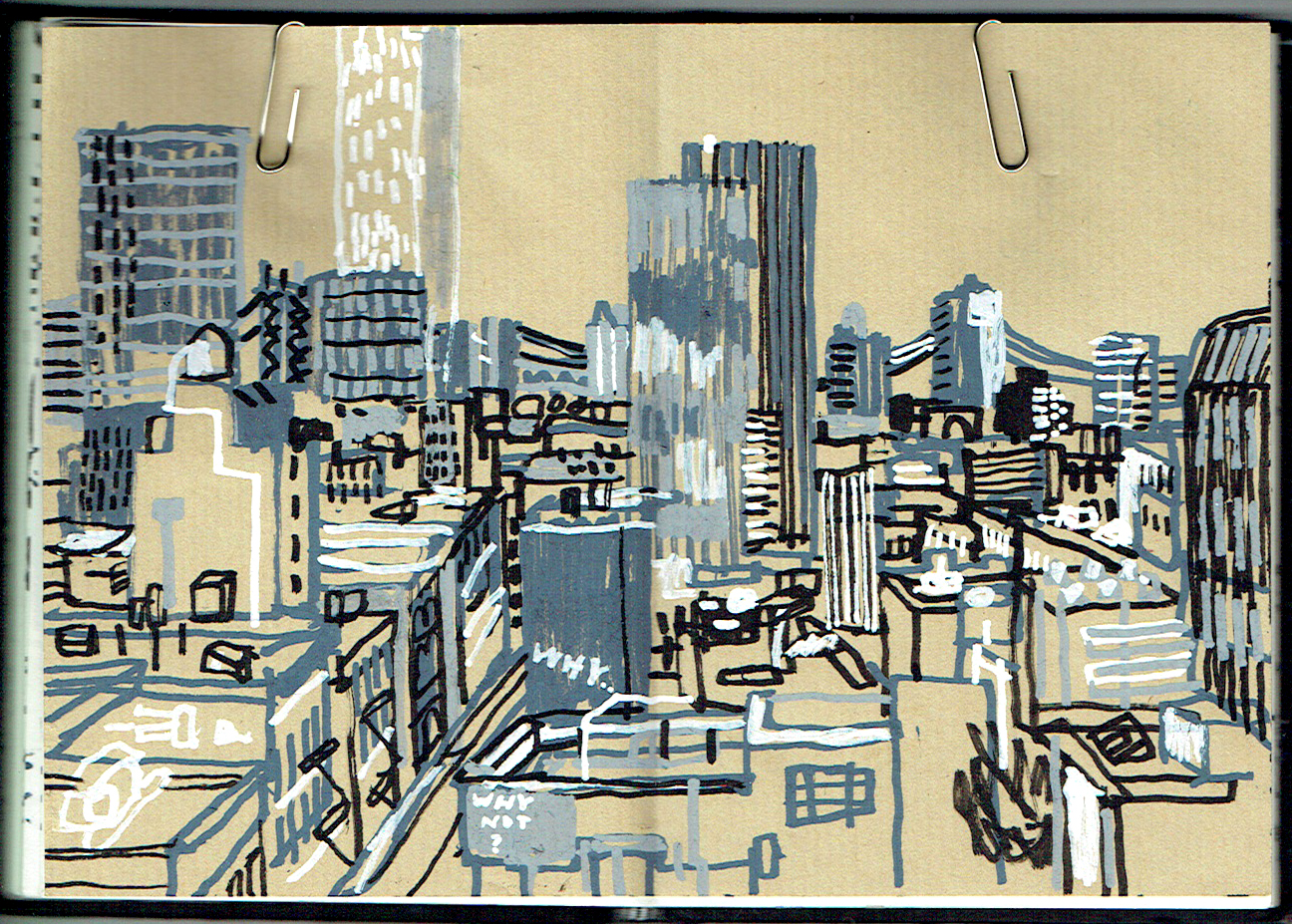
Lower East Side rooftops

Manhattan from Brooklyn Bridge Park I

Manhattan from Brooklyn Bridge Park II

Delancey Street subway

From the Empire State Building looking north(ish)

From the Empire State Building looking north-east

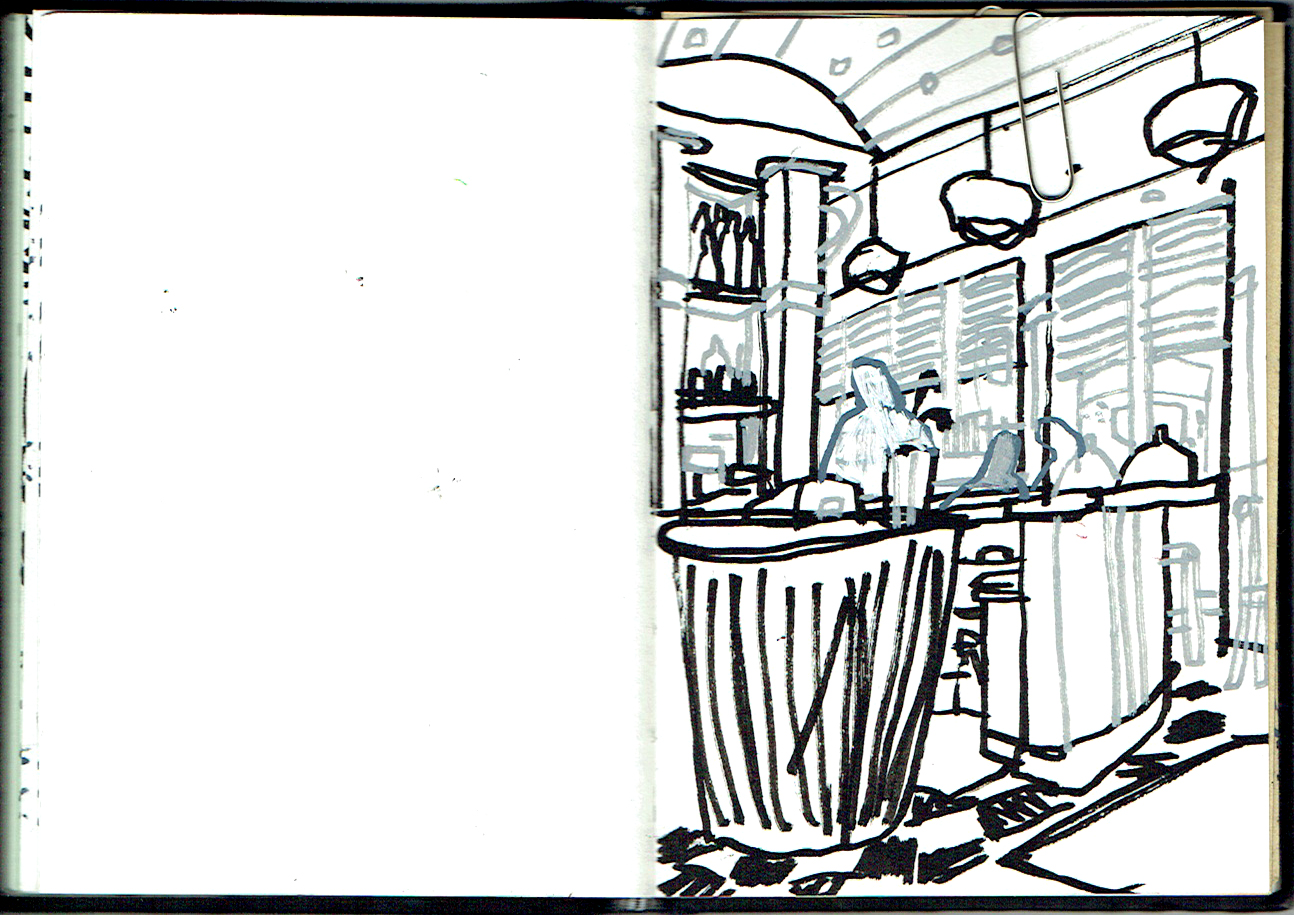
MacDougal Street cafe, Manhattan

The new Essex Market, Lower East Side

Central Park skyline

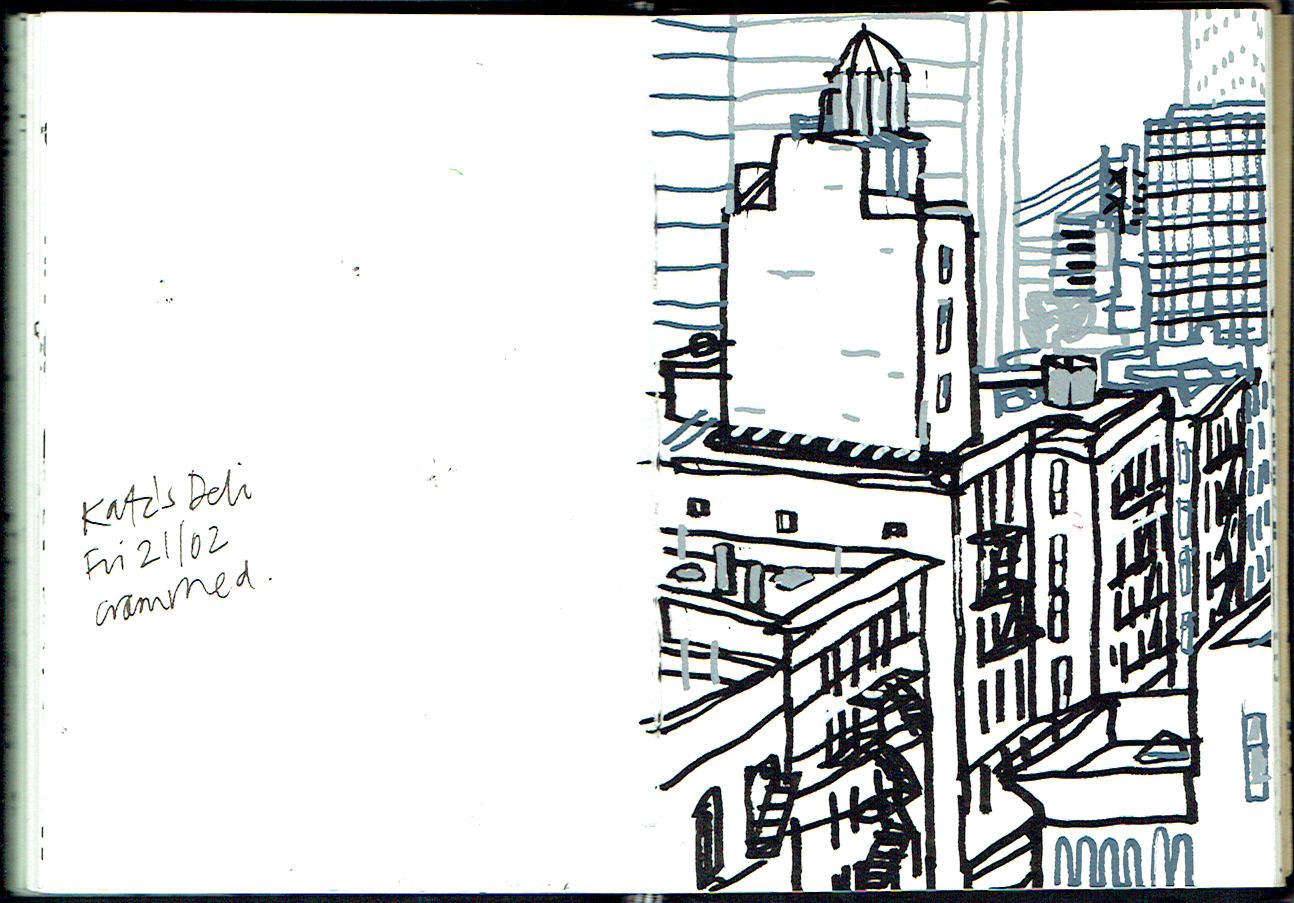
Katz's deli, crammed

Ludlow Street, Lower East Side, and a bridge

Washington Square, New York City

Three bridges: Brooklyn, Manhattan, Williamsburg

Remedy Diner, East Houston Street

Lower East Side from floor 14 (an added page)

Room 514 in the Museum of Modern Art: Man Ray's
Chess Set (1920-26), Brancusi's Blond Negress II
(1933) and Tarsila do Amaral's The Moon (1928).
And a window with a view
I'm on Instagram.


Wednesday, 29 April 2020

Bucklebury, Combe Gibbet and the RAC

James Hobbs, Bucklebury, Berkshire, 1990

Read an introduction to my drawing journey around England, which started 30 years ago

[Bracketed sections like this have been added in 2020.] 

The first night out. I have ducked off the A4 down a narrow road that, by the speed they are going, is well known by the commuters rushing home. I get the idea that the van and I are a rude intrusion into their well-ordered lives, getting under their feet. I dawdle along in the same direction, trying to find the village of Bucklebury: it is spread thinly through the lanes, and I never know quite if or when I have found it.

In looking for places to camp each night I am going to avoid the camp sites whenever I can and knock on peoples' doors to see if they can direct me to some quiet corner, and at least give England's reticent population the chance to say something to me and save money into the bargain. I have driven miles searching for the right sort of place when I come across a large white house at the end of an intimidating gravel drive that I select as my first target for somewhere to stay.

The door flies open to reveal a man in plus-fours and a mobile phone hanging from a belt like a revolver. A lean, elderly, military looking man, barks over to me, "What can I do for you m'boy?" in a colonial sort of way. I tell him what I'm doing and how I am looking for somewhere I can pull in for the night, words I was to repeat hundreds of times over the months.

"Morton! Aha, of course! My father had a bookshelf full! Never did get around to reading any myself."

But he leads me to a small gate down one side of the garden, which goes into a narrow field where I can stop for the night. He leads me past firewood stacked against a hedge to show me where I can park. The pile, he says, has not gone down over the past mild winter - "but it's a dreadful frost valley down here. Down to minus ten last week."

Expressing surprise here was a mistake on my part, and he jumped as if he'd caught me out.

"Towny! You're a towny! Only a towny wouldn't know it's been so bad!"

The sky is ominously clear, and I feel I am about to find it out tonight.

I heat a tin of soup and then follow the footpath that leads through the field to a horse-smelling criss-cross of tracks behind the hedges. There is a leafy wood that muffles the footsteps and every other sound, the acoustics of the English jungle.

But it isn't as silent as it seems. Over the birdsong is the white noise of the M4 and a ceaseless rumble of Heathrow traffic, two inescapable links with another pace of life. Coming back out of the fields as darkness falls I pass a line of bungalows that look over to the woods and click, click, click, their security lights come on one by one.

James Hobbs, Bucklebury Church, 1990

In the morning, my host is up in time to chat with me while the toast burns, painting a vivid picture of the whole of the south of England being overrun with deer, stripping trees of their bark as they go. He's really got it in for me now.

"If you'd been up at a decent time this morning, your..." he points at the van, struggling for the right word, "thing would have been surrounded by them. No education!" he concludes.

I offer him a cup of tea, but he has, after all, not yet concluded, and turned instead to his views on letting the starving of the third world die out naturally rather than being "mollycoddled" by the likes of "us". "Thinning out" he called it.

He waves me off, and I think he will miss me being around to shout at. I stop to draw in a gateway on the way to Bucklebury Church, listening to a cuckoo somewhere across the valley while a stack of pornographic magazines blow around the road. The church is hemmed in between the rectory and post office, now The Old Rectory and The Old Post Office. This is ideal commuting country, encouraged by all those country living articles in the colour supplements. The migration of rich and poor between city and country continues. It seems quite possible though that one day there will be no such thing as a "local".

*****

Even if you are driving around the lanes of Berkshire looking for a gibbet on a hill, it still comes as something of a surprise when you finally come across it. And today probably more so, as, chugging up the hill towards Combe Gibbet, I can make out the unmistakable form of a figure hanging from it.

James Hobbs, Combe Gibbet, Berkshire, 1990

From the twinkling lights reflected from car windows parked on the hill on this hazy warming morning, there is evidently a crowd out to see it. I have never considered myself an ambulance chaser but there is an allure to this macabre sight, and one I can't resist.

Getting closer, leaving the car park and its drowsy occupants with their BBC Radio 3 and vacuum flasks, I can see they are not concerned with the gibbet at all but giving their attention to group of grounded hang-gliders in the next field.

"'Not enough wind, just not enough,"' a helmeted man is saying. He turns to the little group and just for a moment I get the idea he's going to ask us all to blow.

The limp legs hanging from the huge T-shaped gibbet are way out of reach, but a soft stuffing is still visible oozing from one of the trouser-legs. The jacket is packed so tight that the few buttons that are left are popping off. The head is of stuffed sacking. It droops weightily, the noose giving it that same jerked angle you see in old black and white photographs from the hanging heydays.

On the opposite arm of the T, a sign has been hooked, awkwardly written, weathered and calling for good neck muscles and eyesight.
I am a farm worker who earns £120 a week. My rent is £30 a week, food for my wife and I is £60 a week. This leaves me £30 a week for clothes, transport, furniture and all the other things in life. I cannot afford a holiday. How can I afford £4 a week for our poll tax. This is the only way out. Please help to change this unfair system.
[The poll tax or, as the then prime minister Margaret Thatcher insisted on calling it, community charge, was a flat-rate tax that fell disproportionately on the poor. Her insistence on its implementation helped bring her down later in 1990. I came across a few other poll tax demonstrations on the tour.]

As a site for such a protest, you had to hand it to him. How can you resist such an apparition visible across half of Berkshire? The gallow's uses are now certainly few, but the farm nearby is obliged to maintain it in the condition it was in when it was erected to hang two child murderers in the 17th century, the only time it was used. There are signs of recent repair, new wood and metal plates to show it is still observed, and a steady supply of walkers over the hills to stand and watch.

James Hobbs, From Inkpen Beacon, 1990
It is a small point, and one no doubt lost on those about to have the noose about their necks, but there can be few finer views from any gallows. There is a massive expanse of countryside laid out below us, almost totally still except for flocks of birds and a tractor gradually working left to right across a field perhaps a couple of miles away. There are two palls of smoke, one very black, the other blue and emerging vertically from woodland. Several patches of oil seed rape stab yellowness into receding diamond-shaped fields.

The air moves a little, enough to set a body rocking on a gibbet, but still not enough for the hang-gliders.
 
*****

The second night out, and I'm feeling pretty good having parked up a long, disused lane, waking to silence from the fields around, silence even from the skies, but then too silence from the engine, which splutters but does not start. And so my second morning out brings my first appeal to the RAC. With the help of a farm labourer who was happened to be spraying a field nearby we pushed the van to within sight of the road and I set out to look for a phone. [Mobiles were a rarity in 1990.]

There are few more uplifting sights than an RAC roadside recovery van coming around the corner and one I was to find did not diminish with frequency. A man jumps out with a precise moustache slicked into place. He is the nearest thing to Salvador Dalí I have seen. He fiddles with the spark plugs, and I have to turn the engine over from time to time as they are tested.

"And again." It is like a doctor asking me to say "aaah".

"The compressor," he announces. I am still dreading that this may mean the whole journey is over before it has hardly started, when he asks for £1.50 for a replacement. A rummage through my pockets only brings to light £1.24 in assorted change, which he accepts.

As I'm pulling away, he calls to me, words I cannot quite make out. They may well have been: "See you again!"

James Hobbs, 1990

Next: Winchester. Read about it here.

[See more of my drawings on Instagram.]