Wednesday, 11 March 2020

Thirty years on: the van revisited


Thirty years ago, in early 1990, I bought a camper van, packed it with homemade sketchbooks and pencils and, funded by £40 a week from Margaret Thatcher's enterprise allowance scheme, set off around the country for six months retracing the route of an old travel book I'd found in a car boot sale: HV Morton's In Search of England. Once home, I wrote about my experience, exhibited drawings completed on the trip, found a literary agent, and saw a parade of the UK's top publishers politely turn it down.

What since? While most of the 900 drawings have been kept safely in cardboard boxes and occasionally shared online (a selection of them were exhibited at Wolseley Fine Arts, London, in 1996), the 50 chapters have been archived in a series of devices that tell a story of technology since that time. The book was started on a typewriter, completed on an Amstrad and stored on floppy disks, and then passed through a succession of Apple Macs to laptops, the cloud and hard drives, and now to this blog. Over the coming months, to mark the 30 years since I started the journey, I'll be posting chapters from it along with the drawings.

Ludlow's Boots

An admission: these chapters were written and the drawings were done by a man half my age, and the person I am now would do things differently. My story has been given a gentle edit, but I have resisted changing things too much. It represents where I was during those six months. There are parts I wince at, but they survive.

Morton has fared even worse over time. The truth about the hugely popular travel writer, who died in South Africa in 1979, was revealed in Michael Bartholomew's In Search of HV Morton, published in 2004. The way Morton portrayed himself in his books was a carefully constructed work of fiction. There were plenty of warning signs about his character that I became aware of as I followed his route, but I hadn't expected to him to turn out to be the racist, adulterous, hypocritical Nazi-sympathiser that Bartholomew's book reveals him to have been. But, ugly as we can now recognise Morton as being, that too has become part of the story of my journey.

My drawings, only some of which are included in these posts, were done at a formative time of my artistic career. Although I had just come through four years of art education at Hastings College of Arts and Technology and Winchester School of Art, those six months of constant drawing around England saw my work evolve almost beyond recognition. Again, I have kept in some of those early, clunking images, because they too are part of the real  story.

My trip in the van was delayed for a while because of its hideous unreliability and, particularly, a faulty water pump. The date I started my journey, 24 April 1990, was noteworthy in a couple of ways. On that very day, at the Kennedy Space Center, Florida, the Hubble Space Telescope was launched on its own long-term mission to send back to Earth images from the corners of the cosmos, a role it is expected to continue until at least 2030. With humbler technology and a more terrestrial focus, my Fiat 850T camper van trip also started sending back a series of images, except these were images drawn in pencil and from such other-worldly locations as fields near Hereford, front gardens in Bradford-on-Avon and lorry parks in Lincoln.

Read on: Following Morton: the 1990 introduction

You can also follow me, and see more of my drawings, on Instagram.

• The second – and more personally significant – way that the date of my launch around England is worth remembering is that ten years later to that very day, 24 April 2000, my elder brother Dave died of cancer. I have a photo of him with his head under the bonnet of the van that I'll post if I can ever find it.

Wednesday, 4 March 2020

A visit to the Sketchbook Project, Brooklyn


A library dedicated to sketchbooks? We had a family visit to New York recently during which I finally had a chance to visit a place that I've heard a lot about over the years. The Brooklyn Art Library is home to the Sketchbook Project, which consists of more than 40,000 sketchbooks from around the world, submitted by whoever buys a book from the project and then sends it in.

The library, located down an unassuming road just a short L or G train ride away from Manhattan, is in a bookshelf-lined space behind a shopfront. You could almost mistake it for a shop at first, in fact: there's a counter and tables of merchandise, and then, as your eyes adjust to the light, the receding shelves of sketchbooks come into view.

The sketchbooks used for the project are small – 5x7in and 32 pages – and not so space consuming, but because of their lack of a spine they are mostly anonymous when on the shelf. This isn't a place to pick books off the shelf at will and browse at length. The process for handling the books requires placing a request by doing a catalogue search on the provided tablets or on your smartphone through artist's name, subject, locations or tags – or randomly. Within a few minutes, or seconds even, the book is delivered to you by the librarian. (The book's creator even gets a message to say it has been accessed.)

The reasons for this system are obvious, but it can have the effect of stifling the best of serendipity that working your way through a physical shelfload of books would allow. And the search for items is only as good as the metadata. The books are also not curated, so of widely variable standard. This could perhaps be considered an advantage rather than a disadvantage. One of the project's founders, Steven Peterman, told the New Yorker that one of the reasons for setting it up was to subvert the traditional exploitative gallery culture: "We wanted to create a community anti-gallery space that was inclusive of everyone that wanted to be a part of it." But on my own visit I never felt I cracked the search system in such a way that I found a rich seam of exciting work. Some preparation with regards to what I wanted to see on my visit would have been a good idea.


Participants can, for a fee, also have their books digitised, so opening them up to a much wider audience – you can check them out here. Seeing the books online is not the same as holding them in your hands (I'm turning into a cracked record), but it's an accessible route in, wherever you are. A mobile library in the form of a three-wheeled bookmobile (which is parked in the corner of the library) takes examples of the collected books beyond the library's confines on occasions, and there have been tours of the books in the past.


Not everyone is keen on the idea of buying a sketchbook and giving it back to the people they have bought it from (the book becomes theirs while the copyright to your sketchbook's contents remains yours). The project has very recently become non-profit, which will bring new things such as more education programmes, but it is still a good idea to check the small print before participating, which includes:
  1. 1.2. License to Content. By providing Content through the Services, you thereby grant The Sketchbook Project a perpetual, worldwide, non-exclusive, royalty-free, sub-licensable and transferable license to use, reproduce, distribute, prepare derivative works of, display, and perform such Content in connection with the Services and The Sketchbook Project’s (and its successors' and affiliates') business, including without limitation for promoting and redistributing part or all of the Services (and derivative works thereof) in any merchandise or media formats and through any merchandising or media channels...
This may seem like a reasonable price to pay (beyond the financial one) to have your work in this unique sketchbook environment. Here I should admit that several years ago I bought a sketchbook from the project fully intending to submit it, but I never have. It languishes in a drawer next to the desk among a pile of old art materials. The librarian told me it was not too late to finish it and send it in. Maybe I still will.


Brooklyn Art Library is at 28 Frost Street, Brooklyn, NY 11211, USA. It's worth a visit.


Saturday, 8 February 2020

Pictures at an exhibition


There are times while visiting an exhibition when the temptation to draw what is on display becomes too great. As well as making me look at works much more closely than perhaps I would otherwise, drawing exhibits in the sketchbook is a way of taking some of the experience home, an experience that can perhaps dissipate too quickly otherwise. Sifting through my books I realise that I have quite a few of this kind of drawing, although some are inevitably more successful than others.


This was brought into stark relief when we visited the Bridget Riley show at the Hayward Gallery recently: her clinical lines and optical effects and my organic ink swipes don't really work well together. My drawing of her massive Composition with Circles 4, 2004 (above), for instance, lost everything of her original rhythmical arrangement, resembling little more than an array of cack-handed circular tea cup stains, but the process of making it made me look closely at her work's structure – or at least a part of it. It's a process that makes you ask questions about a work, spend time with it, and stops the eye just gliding past. Sometimes it's about more than just the drawing.

I've included some other drawings of works I've encountered at recent exhibitions:

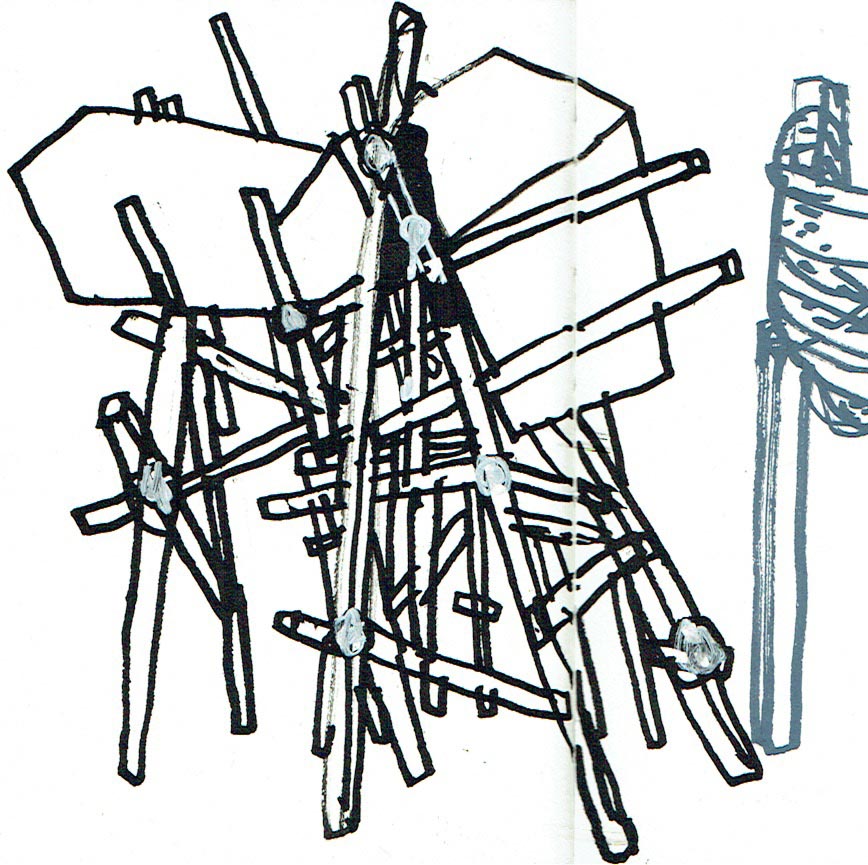
Phyllida Barlow's untitled: blocksonstilts, 2018-19 at the Royal Academy in May 2019 (top image),


Cornelia Parker's Transitional Object (PsychoBarn) at the Royal Academy's courtyard in November 2018,


and Kader Attia's Untitled (Ghardaïa), 2009 (above), and Monica Sosnowska's Pavilion, 2016 (below), both at Tate Modern's Living Cities display in January 2020.


There are more of my drawings on Instagram.


Friday, 20 December 2019

Skaters at the Natural History Museum

London's Urban Sketchers group met at the Natural History Museum last weekend. The conversations and support from the people who go is always more important to me than the actual act of drawing on the day. I spent a bit of time outside the museum drawing people having a good time on the ice rink, and I offer that page from my sketchbook to you here with whatever season's greeting is appropriate to you. Here's to 2020.

There's more information about London's Urban Sketchers here, and you can see more of my drawings on Instagram.


Sunday, 8 December 2019

From London Calling to Never Mind the Bollocks

I’d passed the unassuming church hall behind this church in Highbury New Park around the corner from where we live hundreds of times before I found out that it was, from the 1960s to 2003, a recording studio once owned by George Martin. Here, as the Wessex Studios, the Clash recorded the London Calling album, and the Sex Pistols recorded Never Mind the Bollocks.

As if that wasn’t enough, Tina Turner, Jimi Hendrix, the Specials, Nick Cave, Queen, Madonna, Bjork, the Three Degrees, Elton John, Kylie, the Rolling Stones and many more worked there. The building has now been split up into residential apartments, imaginatively named The Recording Studio.

The writer Douglas Adams lived for a while in a flat in the house immediately next to the church.


Wednesday, 2 October 2019

Inktober in The Artist magazine


To mark this year's Inktober, I've written an article about drawing with ink for the November 2019 issue of The Artist magazine, which was published on 4 October. It features the work of Cynthia Barlow Marrs, Len Grant and Nick Kobyluch, as well as by me. My thanks to all of them. They are all ink-using artists whose work I particularly admire, and who I have interacted with, one way and another, online and in the real world over the years.

They don't all get involved in Inktober, and I don't always. (Inktober is all about sharing images made with ink on social media with the #inktober hashtag.) I certainly do not intend to post an ink image every day through October (although, hey, I'm 100% up to date two days in). But we all have to find the best way for us. Inktober may just give the creative daily impetus that is needed to make a personal breakthrough. Anything that inspires has to be a good thing.

You can see more of my drawings, which are usually in ink in one form or another by going to Instagram. Some of them may even have the Inktober hashtag. Thanks, too, to the nice people at The Artist for publishing it.


Wednesday, 28 August 2019

Two days in Amsterdam


Happy family events meant I could only get to the Urban Sketchers symposium in Amsterdam for a couple of days – neatly arriving shortly before the closing reception. The newly launched direct Eurostar service to Amsterdam from London's St Pancras terminates in the heart of the city, close to both where I'm booked to stay the night, and the location of the symposium's final sketchcrawl around NEMO Science Museum. Bags dropped off, I head off with the small sketchbook and a few pens in an effort to meet old friends and perhaps even get some drawing done.

Korte Prinsengracht/Haarlemmerdijk, Amsterdam

It's a little while since I've been in Amsterdam, and of course things have changed. But one of the joys of going to the symposium is being able to explore a place while continually bumping into friends and acquaintances. Some are tenuously known only online, some are regular mates I've known for years, some I have only met a handful of times at past symposiums but feel like old friends, but all have their sketchbooks out and are communally soaking up the place on paper.

From the NEMO ramp, Amsterdam

Around the NEMO Science Museum there are dense thickets of people engrossed in drawing everywhere you look, standing, sitting on every available spot, on walls, in cafes, legs dangling over the dock. There are familiar faces focused on the job in hand, drawings interrupted by happy reunions, conversations about how to endure the intense heat wave that coincides with the symposium. Later, there is the huge group photograph, of perhaps more than 700 people standing in the sun by the dock: at the back where we stand we become just pixels, but it is enough to be there.

Closed to traffic: Willemsburg, Amsterdam, drawn from the Juice Brothers cafe

The closing reception is big, full on, with a cast of hundreds, and snatched conversations, all too brief. There are too many people to mention by name, but I must mention Gabi Campanario, the founder of Urban Sketchers, who it was great to spend time with again. He launched a fantastic movement more than 10 years ago, one he could never have known would develop as it has. Respect too, to those many people who have joined the vast voluntary operation that it has now become.

Anne Frank's house, behind the tree on the right, Prinsengracht, Amsterdam

The final day was spent around the city, drawing with friends before the time came to board the Eurostar home. Next year's symposium is planned to be in Hong Kong, not such an easy place to visit from this side of the world. It was interesting to see a discussion on Swasky's Instagram about the environmental effects of the symposium through the vast numbers of people it now attracts and the flights inevitably made. In my experience, creative people are more alert to this kind of issue than many, and so perhaps some already take measures to offset their carbon footprint, but when even world leaders refuse to accept there is a problem, the sense of emergency we face on the climate issue can be all too easily dismissed.


From the London-bound Eurostar train window

There are more of my drawings on Instagram.


Sunday, 21 July 2019

From a Greek island


The latest sketchbook has mostly been involved with a longer-than-usual family summer break to the Greek islands. I don't always find beach holidays the most inspirational times in terms of drawing. I find myself writing more in my sketchbooks when I am away at the coast (I've spared you the daily diary that intersperses the drawings that I have included here). But especially when hanging around harbours waiting for ferries (such as above, which shows the new harbour at Mykonos while we waited for our late connection to Paros to arrive) or lingering in cafes, it is inevitable that the sketchbook comes out.


Antiparos is quiet in relation to some other Greek islands and in some ways unchanged since we last visited it the week after Labour came to power in 1997. The harbour (above) looks the same, and the road turns into a dirt track at the same point on our route to our apartment. The sun still shines non stop, and the beaches are still just perfect for lazing in the shade with occasional dips into the sea. I don't think Tom Hanks or Madonna had houses on Antiparos when we were here before, which they seem to have now.


The beach at Psaraliki: we went back a lot, although there were two or three beaches there rather than just one, all a short walk away. The general idea was to get a place under the tamarisks and head for the beachside cafes after a decent length of time spent reading, swimming and not thinking about the UK's dire political situation.


Over on neighbouring Paros, we looked around Naousa and inevitably spent some time later on waiting for the bus back to the ferry port. The normality and banality of the scene there (below), and perhaps most other bus stations, was the most attracting scene to draw of the lot for me. There was time to draw the postcardy scenic alleyways around the castle in Paros (bottom image), but at the bus station there was no pressure to get the overwhelming beauty of the place, but just its everydayness. Which is what I like best.


It was a great holiday.

I'm on Instagram. Some of these images can be found there.


Wednesday, 10 April 2019

This sketchbook: from Brexit to Google's new HQ


Here are six pages from one of my current sketchbooks: an A6 one that I generally use across an open page so the gutter runs down the centre of each image (and hence down the centre of this blog post). The sketchbooks always end up telling a kind of story through what I have drawn in them, and during this one (so far) it seems I have been demonstrating against Brexit (above), travelling on the train to see my dad, drinking coffee in cafes, walking with N, and watching London's skyline change. Here they are, in no particular order.

From the London to Market Harborough train

A walk around Woodberry Wetlands

Cafe in Bloomsbury

St Martin-in-the-Fields and South African Embassy, Trafalgar Square, London

London's new Google HQ rises in King's Cross


Tuesday, 26 February 2019

Five pages from Sheffield and the Peak District


We get the train north from St Pancras to Sheffield, and then head on to Edale in the Peak District, which starts almost as soon as you are out of the city. Standing to draw on Sheffield's street corners with Saturday shoppers all about (above) makes using a pen the natural choice. I prefer to stand up to draw partly because I can work from exactly the point I want to, but also because I can shift around several paces in each direction to make better sense of what I'm looking at. Most importantly, perhaps, is that it means I work quickly and resist the temptation to worry about piddling detail or try to make things look vacuously pretty. There's no need to set out an array of equipment: it's just a pen and a book. I'm not keen to hang around. (The odd bit of colour below is added back in the hotel.)


Barely knowing the city, I end up taking the inevitable choice of city centre subjects, such as the cathedral and winter gardens, rather than the places that may have better represented the city if I'd had more time to explore or arrived with better knowledge. We find some of these places later – the great restaurants of London Road, and the post-industrial grit of Kelham Island – by which time it's too late to draw anyway.


Having travelled on to stay at the Rambler Inn at Edale, thirty minutes away by train, I get the inks out on the window sill to work. The railway line from Sheffield leads up through this valley and behind Lose Hill on the right. It's a less linear scene than found in the city, and the logistics of taking lids off three pots of ink are easier than when working outside, so it seemed a more obvious medium to use. Later, I do another of the same view...


... and then a final one looking out of a window facing towards Kinder Scout. The Peak District strikes me as a more inky kind of place than Sheffield. I'm not saying places always have a medium that is best suited to them, but, for me at least, it seemed like it this time.


You can follow me on Instagram or Flickr. Or even Twitter. Or email me (see contact above).

Monday, 10 December 2018

In the pages of Manchester Sketchbook 2


Two of my drawings, I am happy to say, are included in the new book Manchester Sketchbook 2, which features the work of 36 artists from around the world who took part in the Urban Sketchers symposium in the city in the summer of 2016. Copies of the book – and the first Manchester Sketchbook – are on sale via the website of Simone Ridyard. My thanks to Simone for inviting me to have my work included in it.


Saturday, 1 December 2018

Out now in The Artist

The January 2019 issue of The Artist magazine includes an article by me about how sketchbooks are laboratories for experimentation and play, and not necessarily places to make pristine works that aim to garner likes on social media. Our most "liked" works aren't always the ones leading us in the best direction.

Thanks to Isabel Carmona, Liz Loxton, Swasky and Lis Watkins, whose works are featured in the article.

Monday, 19 November 2018

On letting go


I've often thought that the process of drawing has similarities with the ups and downs of form experienced by sportspeople. Sometimes things flow effortly, and then at other times it can seem like hard work, when nothing goes as you'd hoped. I was reminded of this while reading On Cricket, a new book by the former England captain and psychoanalyst Mike Brearley. A passage in it refers to playfulness and losing inhibitions:

"... I think that writing, like playing cricket, like, in fact, many activities of life, involves at best a benign sort of marriage between discipline and spontaneity, between hard work and playfulness, between letting go of conscious control and the application of sometimes critical thought."


Of course, it doesn't always work out as you'd like. The playfulness can easily come unstuck. In terms of drawing, that is what sketchbooks can be for: an arena for coming unstuck and being spontaneous, and occasionally, sometimes (and not necessarily in the images included here) an uninhibited zone where you can happily surprise yourself, buoyed up by all that experience, hard work and discipline. And not mind whether they gather two likes on social media or two thousand.


From the top: the view from the top of Tate Modern looking towards Blackfriars Bridge, three scenes from a moving train going to the Midlands from London, and Cornelia Parker's Transitional Object (PsychoBarn) in the courtyard of the Royal Academy, London.


Wednesday, 3 October 2018

Postcards in Tate Library


In the latest example of things I have made heading off into the world and having a life of their own, a set of four postcards of my drawings and other items relating to an exhibition of my work at Wolseley Fine Arts, London, in February 1996 are now in the Tate Library at Tate Britain. In 1990, I spent six months drawing my way around England, culminating in that show.

Clockwise from top left: Ludlow Boots; the spires of Shrewsbury; Saxon Church, Bradford on Avon; Roman Baths, Bath.

Thursday, 30 August 2018

Five days in Porto


I didn't get any drawing done on my first day in Porto. That was partly because it was a new city for me, and I was always left wondering what was around the next corner, and partly because it was a day for meeting and talking with people that I rarely, if ever, get to meet in person. To walk along by the river Douro that day was to bump into a stream of familiar friendly faces to greet (Elizabeth Alley, James Richards, Marissa Swinghammer, Melanie Reim to mention a few), which, being in a foreign land, is an odd sensation.

The ninth Urban Sketchers symposium (18-21 July 2018) was a bit like the gathering of the clan: around 800 people from more than 40 countries who draw on location descended on the city for the four days (although most, it seemed, arrived earlier or stayed later, or both). Everywhere you turned there was someone drawing, or people sharing their sketchbooks, or throwing their arms around an old mate.

Perhaps the talking was more important than the drawing (below I post some of my drawings from the five days I was in Porto). Within an hour of arriving in Porto I was meeting with the rest of the lovely USk editorial team: we work together on the international blog, communicating almost daily by email, but never as a complete group in person. We still weren't all present (Marcia Milner-Brage and Murray Dewhurst were missed), but it was close. (Image left to right: me, Gabi Campanario, Suhita Shirodkar, Béliza Mendes, USk president Amber Sausen, and Tina Koyama. Photo courtesy of Tina.)

This was the moment when I finally got to meet Gabi, the founder of USk, someone I consider an old friend, but who I had never met before. We first exchanged emails nearly ten years ago when I heard about Urban Sketchers. I'm proud to have had my drawings featured in his books, and he has kindly agreed to be in mine. Truth be told: finally getting to meet and spend time with Gabi was a much-anticipated highlight of my Porto days.

The remaining days were a rush of meeting old friends, making new ones, staying up too late, laughing over dinner, wondering how Porto is going to manage with the huge influx of tourists that we were part of, and drawing, drawing, drawing. There are too many names to even begin mentioning them here, but it was great being with you all. Happy days.

Some drawings:


Rua Chã, Porto: an alleyway I'd pass each day on my walk between the hotel and symposium centre.

Armazéns Cunhas department store, Porto.


Praça a Guilherme Gomes Fernandes, Porto.


St James's British cemetery, Porto: a group of us jumped into a minibus and spent a cooling morning drawing there. An entertaining lunch with Stuart Goss and Joaquim Espadaneira followed.


São Bento railway station: the Friday afternoon sketchwalk.


The view from the steps of São Bento railway station.


Virtudes garden, Porto: the Saturday morning sketchwalk.


Igreja dos Carmelitas and Igreja do Carmo, Porto. I drew this one to replace one of the same subject that was sold to Richard Briggs in the last evening's silent auction. Thanks, Richard.


City Hall, Avenida dos Aliados, Porto: the big final sketchwalk on the Saturday afternoon. Beneath this, out of sight, are around 800 people busily drawing.


From Rua de Ferreira Borges, Porto, looking east, with the cathedral in the background.


The House of Sandeman, across the river Douro, with the cable car that runs between the bridge and the waterfront.

Next year, it's all happening in Amsterdam.